Introduction
Ceramic Plaque
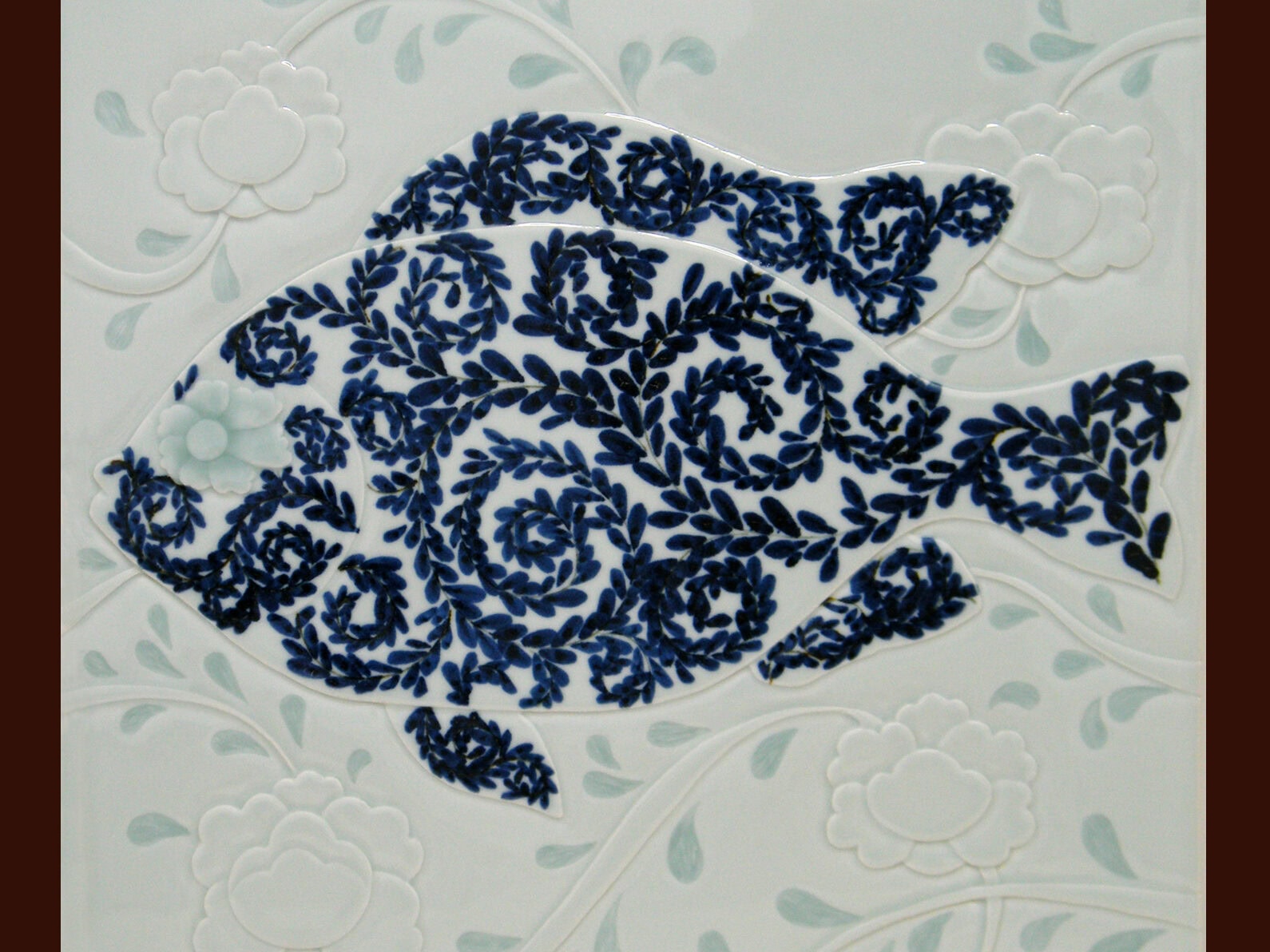
This artwork is a square decorative Ceramic Plaque designed with a flat, balanced, and symmetrical profile. Its dense porcelain body maintains a consistent thickness, creating a stable surface for detailed relief carving and underglaze decoration. The format allows the piece to function as both a framed wall artwork and a freestanding decorative object displayed on a shelf, console, tea-room cabinet, or exhibition stand. Its clean square outline gives the Ceramic Plaque a contemporary architectural quality while preserving the character of traditional Jingdezhen porcelain art.
The Ceramic Plaque features a three-layer relief structure that creates clear visual depth. The base layer consists of shallow-relief peony vines arranged around the composition. Pale celadon washes are applied to the leaves and petals, producing a soft, restrained background. The middle layer contains two overlapping fish silhouettes of different sizes. Their staggered placement establishes a natural sense of distance, allowing one fish to appear closer while the other recedes slightly into the background.
The upper layer forms the visual center of the Ceramic Plaque. Raised underglaze-blue scrolling vines are carefully built up by hand across the bodies of both fish. These continuous vine patterns fill the fish silhouettes without making them appear heavy or rigid. A pale celadon lotus flower decorates the head of each fish, creating a visual connection between the blue fish bodies and the softer background.
The varying heights of the three decorative layers give the surface a rich sculptural quality that changes with the viewing angle and surrounding light.
The composition follows a clear hierarchy in which the background patterns support the double-fish centerpiece. Shallow-relief peony vines encircle the base layer, while the two fish overlap across the upper portion of the Ceramic Plaque. Scrolling vines flow through their bodies, and lotus flowers create visual anchors at the heads. This arrangement establishes an inward and outward rhythm, guiding the viewer’s eye from the surrounding peonies toward the fish and then through the continuous vine patterns.
Each motif carries a traditional Chinese meaning. Fish are associated with abundance because the Chinese word for “fish” sounds like the word for “surplus.” A pair of fish therefore expresses wishes for harmony, completeness, and abundance year after year. Peonies symbolize prosperity, honor, and good fortune, while lotus flowers represent purity, balance, and harmony. Continuous scrolling vines suggest enduring vitality and long-lasting blessings. Together, these elements give the Ceramic Plaque a layered message of prosperity, elegance, continuity, and well-being.
The work moves beyond the visual limitations of conventional flat porcelain painting by combining ceramic relief sculpture with underglaze-blue painting. Soft celadon peonies create a quiet background, while the darker raised double-fish forms become the main visual focus. The pale blue lotus flowers act as transitional accents. Contrasts between light and dark, high and low, and foreground and background create a measured visual rhythm across the Ceramic Plaque.
The scrolling vine lines are painted with several shades of cobalt blue to reproduce the soft diffusion and tonal variation of traditional ink-wash painting. Dark blue areas emphasize the main structure, while lighter washes soften the transitions between patterns. Large areas of exposed white porcelain provide breathing room and reflect the Eastern aesthetic principle of intentional blank space. The restrained combination of cobalt blue, pale celadon, and porcelain white gives the Ceramic
Plaque a refined appearance without excessive decoration.
Rooted in Jingdezhen’s long heritage of underglaze-blue painting and porcelain-plaque relief, this work introduces a more complex three-layer decorative method. It brings together three traditional symbols—peonies, double fish, and lotus flowers—and reinterprets them through modern abstract lines and simplified forms. Instead of directly reproducing an old pattern, the Ceramic Plaque transforms traditional auspicious imagery into an artwork suitable for contemporary interiors and everyday cultural spaces.
Producing this multi-layer Ceramic Plaque requires precise control throughout forming, drying, glazing, and firing. The raised vines and overlapping relief surfaces create a narrow firing window. If the porcelain body shrinks unevenly, the plaque may warp; if the glaze is too thick or the temperature is not properly controlled, glaze may collect around the raised details and obscure the design. The cobalt pigment must also retain enough tonal variation after firing to distinguish the scrolling vines, fish silhouettes, and surrounding decorative layers.
Because underglaze pigment, glaze thickness, kiln temperature, and firing atmosphere naturally interact, each finished Ceramic Plaque develops slightly different blue tones and surface details. Minor variations in cobalt diffusion and relief texture are part of the handmade process rather than defects. These subtle differences ensure that no two pieces appear completely identical, giving every plaque its own visual character and collectible appeal.
The balanced square silhouette makes the Ceramic Plaque suitable for neo-Chinese, Zen-inspired, minimalist, contemporary, and light-luxury interiors. It can be displayed individually as a focused wall artwork or combined with single-fish plaques from the same collection to create a larger ceramic wall installation. The modular format also allows designers to arrange several plaques horizontally, vertically, or in a symmetrical group, depending on the dimensions and atmosphere of the space.
In residential settings, the Ceramic Plaque works well in tea rooms, studies, entryways, living rooms, and private collection spaces. In commercial interiors, it can be incorporated into hotel lounges, restaurants, reception areas, cultural venues, galleries, and boutique retail displays. Directional lighting can emphasize the raised surface, allowing shadows to shift gently across the peonies, fish, lotus flowers, and scrolling vines throughout the day.
Combining sculptural depth, painterly expression, technical craftsmanship, and decorative function, this Ceramic Plaque offers value as wall art, a handmade ceramic collectible, and a reference piece for relief-based porcelain craftsmanship. It presents a contemporary interpretation of Jingdezhen ceramic art while preserving the cultural meaning of traditional auspicious motifs. The result is a premium art porcelain plaque that unites sculpture, painting, symbolism, and interior decoration in one carefully balanced composition.