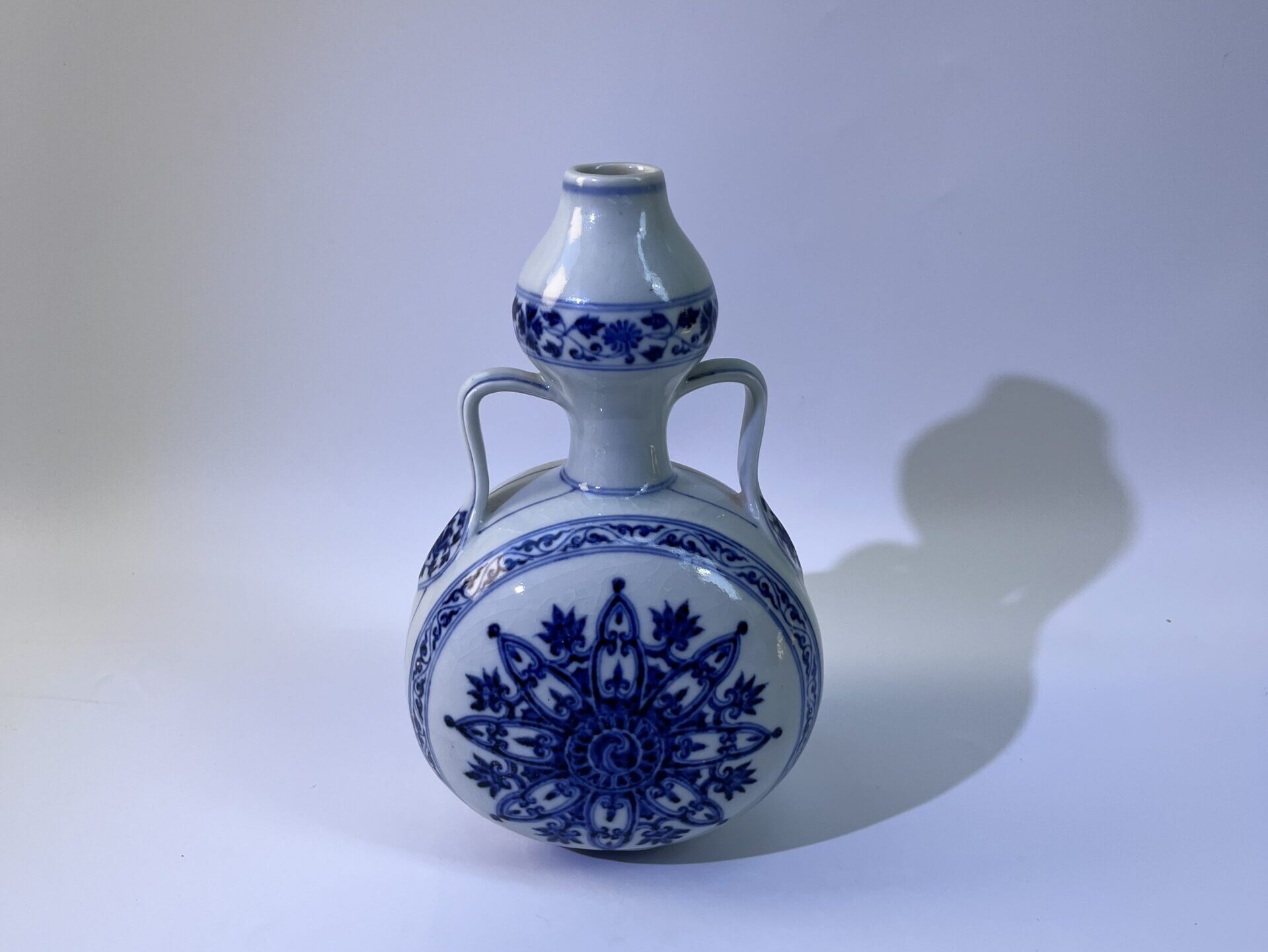
Imitation Ming Xuande Blue-and-White Floral Medallion Double-Gourd Flask with Ribbon Ears, Handmade Antique-style Porcelain
chinese antique-style porcelain, Imperial jingdezhen porcelainreproduction porcelain, jingdezhen ceramic reproduction manufacturer china, chinese porcelain replica, jingdezhen antique porcelain replica, jingdezhen porcelain, jingdezhen ceramics, blue and white porcelain, magic cube ceramics,
Introduction
1. Name & Category
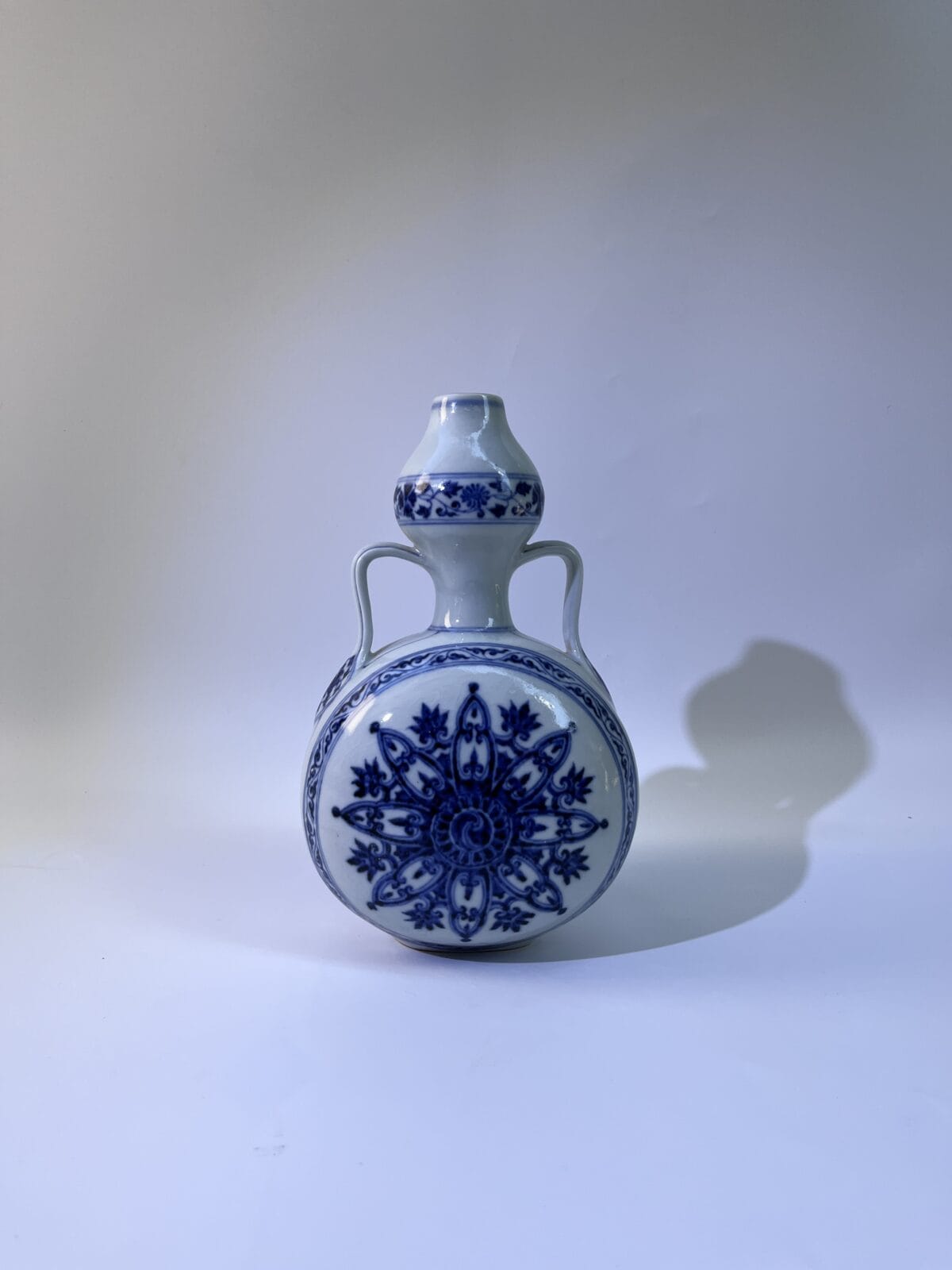
Name: Imitation Xuande Blue and White Flat Gourd Vase with Scroll Ribbon Ears and Wheel Floral Patterns
(Common aliases: Blue and White Moon Flask, Flat-Belly Gourd Vase)
Category: Handmade antique blue and white porcelain crafted in Jingdezhen. Its prototype follows official kiln standards of the Xuande reign of the Ming Dynasty, ranking as a representative heavy ornamental ware embodying integrated Chinese and Western culture during the Yongle and Xuande periods.
2. Core Craftsmanship
The porcelain body adopts a dual formula of porcelain stone and kaolin clay and is fired at a high temperature above 1280°C. The entire surface is hand-painted with blue and white decorations. The cobalt pigment recreates the hue of imported Ming-dynasty Suma Li Qing cobalt ore, forming natural rust spots and ink diffusion textures on densely pigmented areas to restore the powerful, profound artistic features of Yongle and Xuande blue and white porcelain.
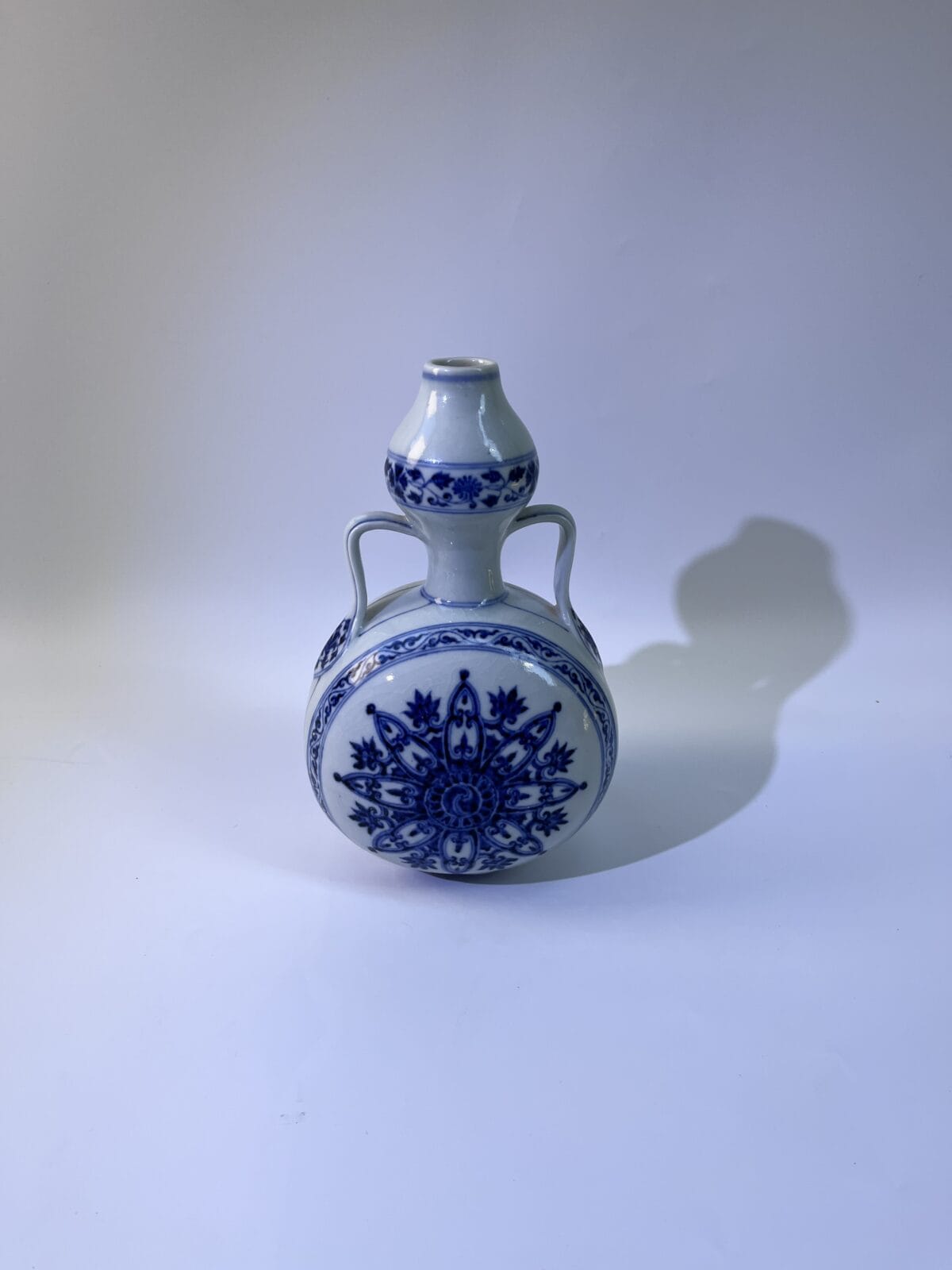
It features a classic exotic silhouette: a small gourd-shaped mouth with a long neck on the upper part, a flat oval belly at the bottom, symmetrically attached ribbon-shaped ears on both sides, and a supporting ring foot. Decorations are arranged in rigorous layers. The neck is adorned with interlocking floral patterns, while the two square panels on the belly are painted with treasure lotus wheel patterns boasting symmetrical and regular geometric structures bearing distinct Islamic decorative styles from West Asia, a typical decorative feature formed through cultural exchanges along the Maritime Silk Road in the early Ming Dynasty.
3. Functions
Its original prototype served exclusively as ornamental appreciation wares in the Ming imperial palace, and was also presented as royal diplomatic gifts to foreign tribes. Nowadays, it is used for high-end display in Chinese-style studies, antique shelves and entrance halls, standing out as a highly culturally recognizable shape among antique porcelain collections.
4. Standard Dimensions
Listed below are mainstream universal specifications for antique flat vases with ribbon ears of equivalent craftsmanship in Jingdezhen, adopted by most elaborate reproductions on the market:
- Overall Height: 26–29 cm
- Belly Width (widest point of flat belly): 18–21 cm
- Base Diameter: 7–9 cm
- Mouth Diameter: 3.5–4.5 cm
This classic medium ornamental vase boasts a dignified and unique shape, suitable for display in most Chinese-style residences and clubs.
5. Logic of Market Value Composition
The value of such antique blue and white flat vases follows the universal pricing system of the antique porcelain industry, supported by three core dimensions.
Value Anchor of Cultural Relic Prototypes
The flat gourd vase with ribbon ears is a landmark ware of Yongle and Xuande official kilns. Derived from West Asian metal vessels, it is exotic-style ornamental porcelain exclusively crafted for the imperial court. Intact authentic specimens are extremely scarce, most preserved in the Palace Museum, National Palace Museum (Taipei) and top overseas cultural institutions. Comparable genuine official-kiln flat vases from Yongle and Xuande reigns often fetch transaction prices ranging from several million to tens of millions RMB at auctions. The scarcity, artistic attainments and cross-cultural attributes of authentic imperial wares constitute the core value foundation of modern reproductions.
Cost Support for Production
- Extremely high forming difficulty: As an irregular flat-belly ware, it cannot be shaped via conventional wheel-throwing. Craftsmen adopt slab forming to create two separate halves of the belly before bonding them together by slip, then manually attach ribbon ears on both sides. Precise control over body thickness and joint flatness is highly demanding. Uneven stress on the body during firing frequently causes deformation, cracking and detached ears or feet, yielding a finished product rate of merely around 30%. Material loss costs are far higher than those of regular round porcelain wares.
- Prominent technical barriers: The geometric symmetry required for belly wheel floral patterns imposes strict standards on painters’ line precision and layout neatness. To reproduce the natural rust spots and diffusion effect of Suma Li Qing cobalt ore, repeated adjustments to cobalt ratios and kiln position trials are required, resulting in much higher labor and trial-and-error costs than ordinary antique porcelain decorated with floral patterns.
6. Historical & Craft Stories Behind the Ware
6.1 Imperial Kiln Treasure Forged by Silk Road Civilizations
The creation of this flat vase itself stands as the most vivid physical record of the Ming Maritime Silk Road.
During the Yongle and Xuande reigns of the Ming Dynasty, Zheng He led seven maritime expeditions to the Western Seas. While exporting Chinese porcelain and silk overseas, he also introduced vessel shapes and decorative patterns from West Asia to the Central Plains. The prototype of this ribbon-eared flat vase was originally a flat metal water jug popular in Arab regions, portable for nomadic travel. Imperial kiln craftsmen integrated it with indigenous blue and white techniques, transforming it into porcelain ornamental wares reserved for imperial appreciation and frequently presented as state gifts to envoys from Western Regions and West Asia.
The wheel floral patterns, also known as treasure lotus roundel patterns, combine Islamic geometric motifs with traditional Chinese treasure lotus flowers, featuring symmetrical, intricate and exquisite layouts—the most exotic decorative pattern seen on Yongle and Xuande blue and white porcelain. Paired with Suma Li Qing cobalt ore brought back by Zheng He, the finished blue glaze presents rich, profound tones with naturally formed rust spots. The ware merges the mild elegance of Central Plains porcelain and the unrestrained vitality of Western Asian culture, emerging as a perfect carrier of Sino-Western cultural integration during the Age of Discovery.
In ancient times, such flat vases were only fired in small batches at imperial kilns due to extreme forming difficulty and high rejection rates. Even within the Ming Dynasty, they ranked as rare imperial treasures barely accessible to common civilians.
6.2 Modern Reproduction: Persistence and Adherence to Ancient Craftsmanship
When recreating this flat vase in contemporary Jingdezhen, the greatest challenge lies not in accurately copying patterns, but in crafting the irregular vessel into a perfectly regular shape.
High-fidelity antique reproductions reject mass slip casting molds and stick entirely to hand slab forming. Craftsmen beat clay into slabs, mold two halves of the belly against molds, repeatedly trim to thin the body, bond the two halves with clay slip, smooth all seams, and finally attach the two ribbon ears. The forming process alone consumes three to four times the labor hours required for regular round wares; weak joints will rupture entirely inside the kiln.
Firing carries huge uncertainties. Uneven body thickness triggers deformation, warped bellies and fallen ears with tiny fluctuations in kiln temperature. Many veteran kilns only yield two or three intact pieces out of ten fired blanks, which is already considered fortunate. Painting also demands consummate skill: wheel floral patterns demand absolute symmetry, with a one-millimeter deviation ruining the overall aesthetic rhythm. Painters draw with rulers for alignment while retaining natural brush vitality to avoid the rigid look of machine decals.
A well-made antique flat vase possesses distinctive visual appeal at first glance. More than just a replicated vessel, it revives the splendid legacy of the six-hundred-year-old Maritime Silk Road and the aesthetic sparks ignited by collisions between diverse civilizations. Serving as a unique ornament for Chinese-style interiors, it stands as a miniature epitome of cross-ocean cultural communication history.