Jingdezhen Porcelain: All Things Born of Porcelain
News 2026-07-22 94
Chinese Foreign Ministry Spokesperson Promotes Jingdezhen, the Porcelain Capital, to the World
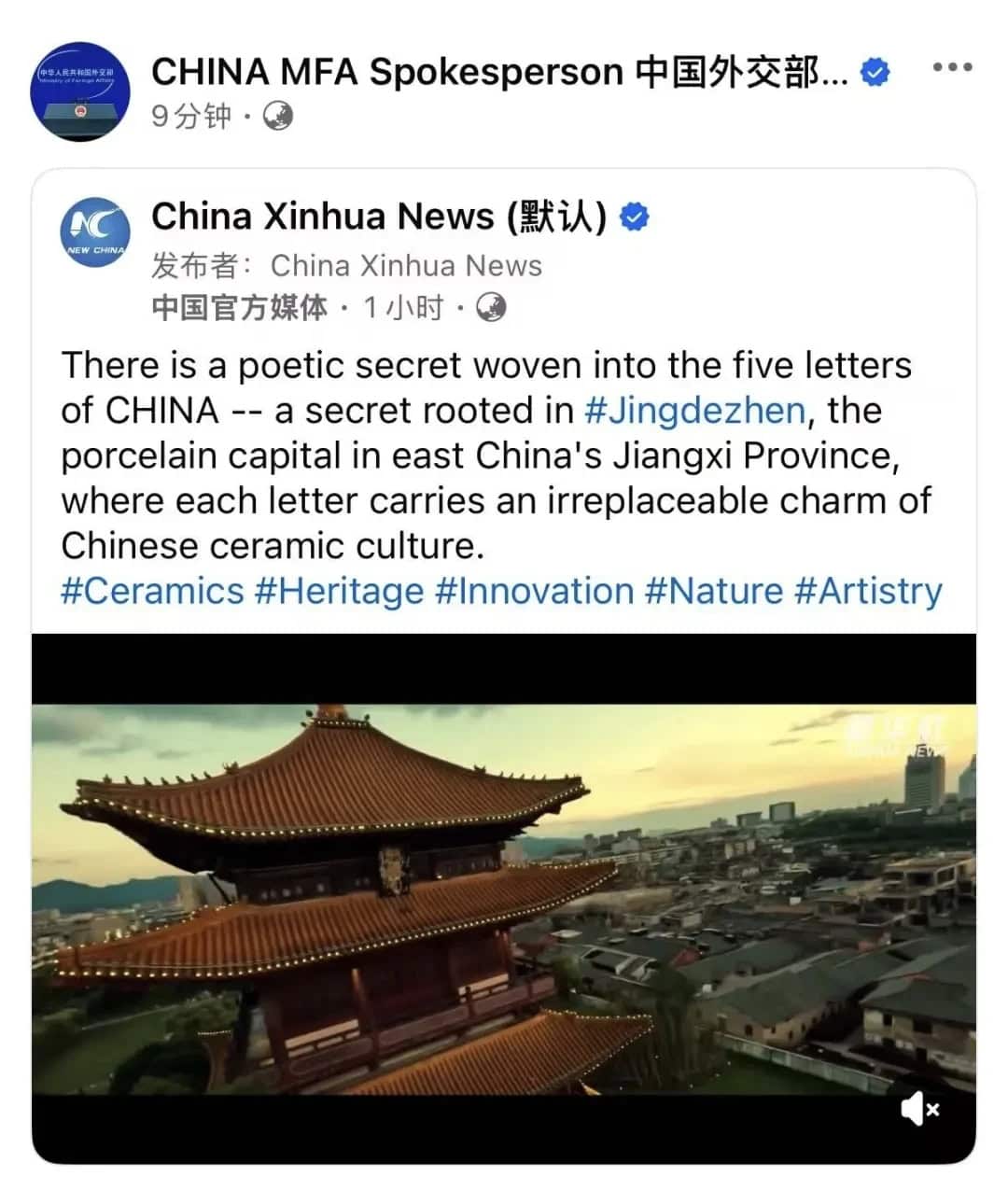
Recently, Xinhua News Agency released the video Jingdezhen, China: All Things Born of Porcelain. The video was shared by a spokesperson for China’s Ministry of Foreign Affairs on overseas social media platforms, introducing Jingdezhen—the renowned “Porcelain Capital”—to audiences around the world and presenting the timeless beauty of Chinese porcelain.
According to the report, this marked the 15th time this year that the Foreign Ministry spokesperson had highlighted Jiangxi Province. Each appearance offers international audiences another opportunity to discover the landscapes, traditions, industries, and cultural heritage of the region historically known as Ganpo. Through these stories, local culture becomes part of a broader and more accessible story about China.
A Global Introduction to Jingdezhen Porcelain
The word “China” refers to the country, while lowercase “china” is also used in English to mean fine porcelain. This linguistic connection reflects the important role Chinese porcelain played in international trade and cultural exchange. For centuries, porcelain traveled from China to different parts of the world by land and sea. Its materials, shapes, colors, and decorative patterns influenced dining culture, interior design, painting, furniture, and decorative art in many countries.
A Thousand Years of Porcelain-Making Heritage
Often described as China’s Porcelain Capital, Jingdezhen has a porcelain-making tradition stretching back more than 1,700 years. Generations of craftspeople have transformed porcelain stone, kaolin, water, glaze, pigment, and fire into vessels known for their refined bodies, delicate surfaces, and artistic decoration. UNESCO describes Jingdezhen as an important ceramic production center whose porcelain has been appreciated both in China and worldwide.
Porcelain culture in Jingdezhen is not preserved only in museums or ancient kiln sites. It remains part of everyday life. Ceramic workshops, factories, artists, designers, glaze specialists, mold makers, painters, and kiln workers continue to contribute to the city’s active porcelain industry. Traditional skills are passed down through families, workshops, educational institutions, and professional production teams.
Every finished piece requires the cooperation of many people and many processes. Clay must be selected, refined, and prepared. The body is formed, dried, trimmed, glazed, decorated, and fired. Depending on the product, it may undergo several firings before reaching its final appearance. Temperature, glaze thickness, kiln atmosphere, and firing time must all be carefully controlled. Even a small change can affect the color, shape, gloss, or texture of the finished porcelain.
Traditional Craftsmanship Meets Modern Innovation
This is why Jingdezhen porcelain represents more than visual beauty. It reflects patience, technical knowledge, teamwork, and the continuous pursuit of quality.
Porcelain artists have always drawn inspiration from nature. Mountains, rivers, clouds, flowers, birds, fish, and seasonal changes appear repeatedly in traditional ceramic decoration. Blue-and-white porcelain uses flowing cobalt lines to create landscapes and natural scenes. Monochrome glazes express the colors of jade, sky, water, leaves, and earth. Relief carving and sculptural decoration allow natural textures to be seen and touched.
In this way, porcelain carries the spirit of the natural world. Clay comes from the earth, water gives it form, and fire gives it strength. Every vessel brings these elements together through human craftsmanship.
Heaven and Earth Reside in Every Porcelain Vessel
The video’s title, All Things Born of Porcelain, captures this relationship. In Jingdezhen, porcelain is not limited to plates, bowls, cups, or vases. It can become sculpture, jewelry, furniture, architectural decoration, murals, public art, or large-scale installations. Traditional techniques continue to find new applications as contemporary designers combine handcraftsmanship with digital modeling, modern molds, new glaze research, and international design ideas.
This balance between tradition and innovation gives Jingdezhen porcelain its continuing vitality. Craftspeople preserve historic knowledge while adapting products to modern homes, hotels, restaurants, commercial spaces, and global markets. Young artists and international creators also come to the city to study, experiment, and collaborate, bringing new perspectives to its established ceramic culture.
For international buyers, Jingdezhen offers more than a wide selection of porcelain products. Its value lies in the complete ceramic supply chain, specialized craftsmanship, product-development resources, and ability to support both functional and artistic projects. From custom tableware and tea sets to decorative vases, ceramic murals, and site-specific art installations, different ideas can be developed through the city’s manufacturing and creative network.
Only in Jingdezhen can visitors fully experience this distinctive relationship between material, craftsmanship, history, and daily life. Here, porcelain is not simply manufactured—it is studied, designed, painted, fired, used, collected, and continually reinvented.
Heaven and earth reside in porcelain; every vessel nurtures all things. Through porcelain, Jingdezhen continues to share the creativity, craftsmanship, and cultural depth of China with the world.