China Ceramic Tableware Exports Reached US$6.90 Billion in 2025: What Buyers Should Know in 2026
News 2026-11-17 50
Jingdezhen, China — 17 November 2026
China Ceramic Tableware Exports reached approximately US$6.90 Billion in 2025 when two key Harmonized System categories are combined: HS 691110, covering tableware and kitchenware of porcelain or china, and HS 691200, covering ceramic tableware, kitchenware and other household articles.
The figure comes from World Bank WITS data sourced from UN Comtrade and equals an exact combined reported value of US$6.90180478 billion. US$6.90 Billion is the sensible headline number; the extra digits are mainly useful for accountants and unusually enthusiastic spreadsheet fans.
The scope matters. This is not the value of every ceramic product exported by China, and it is not a count of custom orders alone. HS 691200 also includes other ceramic household articles. In this article, China Ceramic Tableware Exports therefore refers specifically to the combined value of HS 691110 and HS 691200. That careful definition makes the number useful rather than merely impressive.
For 2026 buyers, the main story is not only the size of the market. Export value slipped slightly while shipped weight increased. In other words, more kilograms crossed borders, but they generated a little less declared value. A dinner plate may look calm on the table, but the trade data underneath it is doing quite a workout.
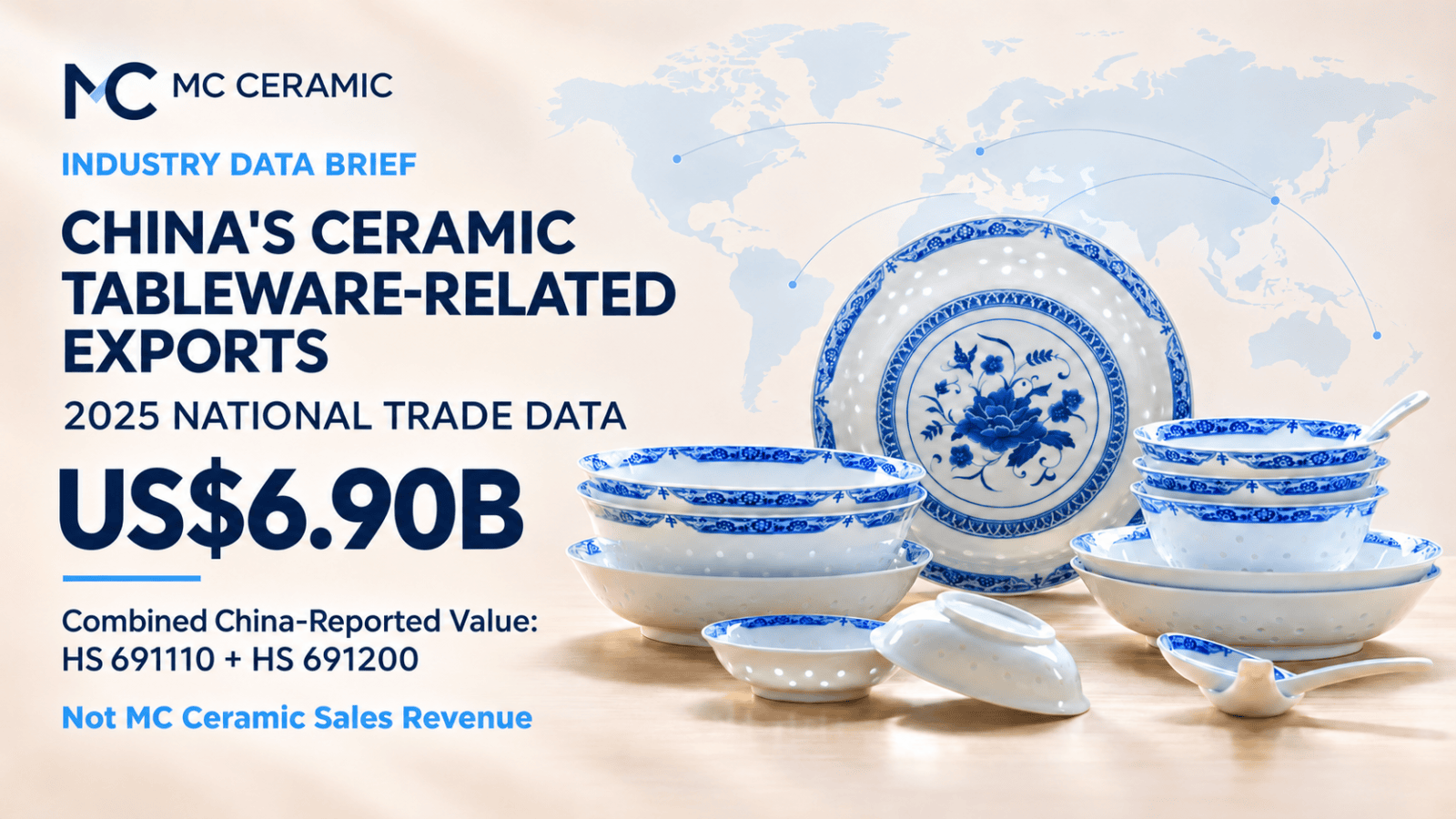
Caption: China Ceramic Tableware Exports reached US$6.90 Billion across HS 691110 and HS 691200 in 2025.
What the US$6.90 Billion Figure Includes
WITS reports that China exported US$6.41325054 billion and 2.3387 billion kilograms under HS 691110 in 2025. HS 691200 added US$488.55424 million and 178.476 million kilograms.
Together, China Ceramic Tableware Exports in these two categories totaled US$6.90180478 billion and 2.517176 billion kilograms.
The same calculation for 2024 produces US$7.01273293 billion and 2.371645 billion kilograms. The 2025 total value was therefore 1.6% lower year on year, while quantity was 6.1% higher. Dividing value by weight gives an average declared value of about US$2.74 per kilogram in 2025, compared with approximately US$2.96 in 2024—a decline of roughly 7.3%.
That last calculation is a trade-value indicator, not a universal price list. It can move because of changes in product mix, destination, material, decoration, packaging, contract terms and market pricing.
It does not prove that every bowl became 7.3% cheaper. Anyone offering that conclusion should probably step away from the calculator and have a cup of tea.
Data Snapshot
| Metric | 2024 | 2025 | Change |
|---|---|---|---|
| Combined export value | US$7.013B | US$6.902B | -1.6% |
| Combined reported quantity | 2.372B kg | 2.517B kg | +6.1% |
| Average declared value per kg | US$2.96 | US$2.74 | -7.3% |
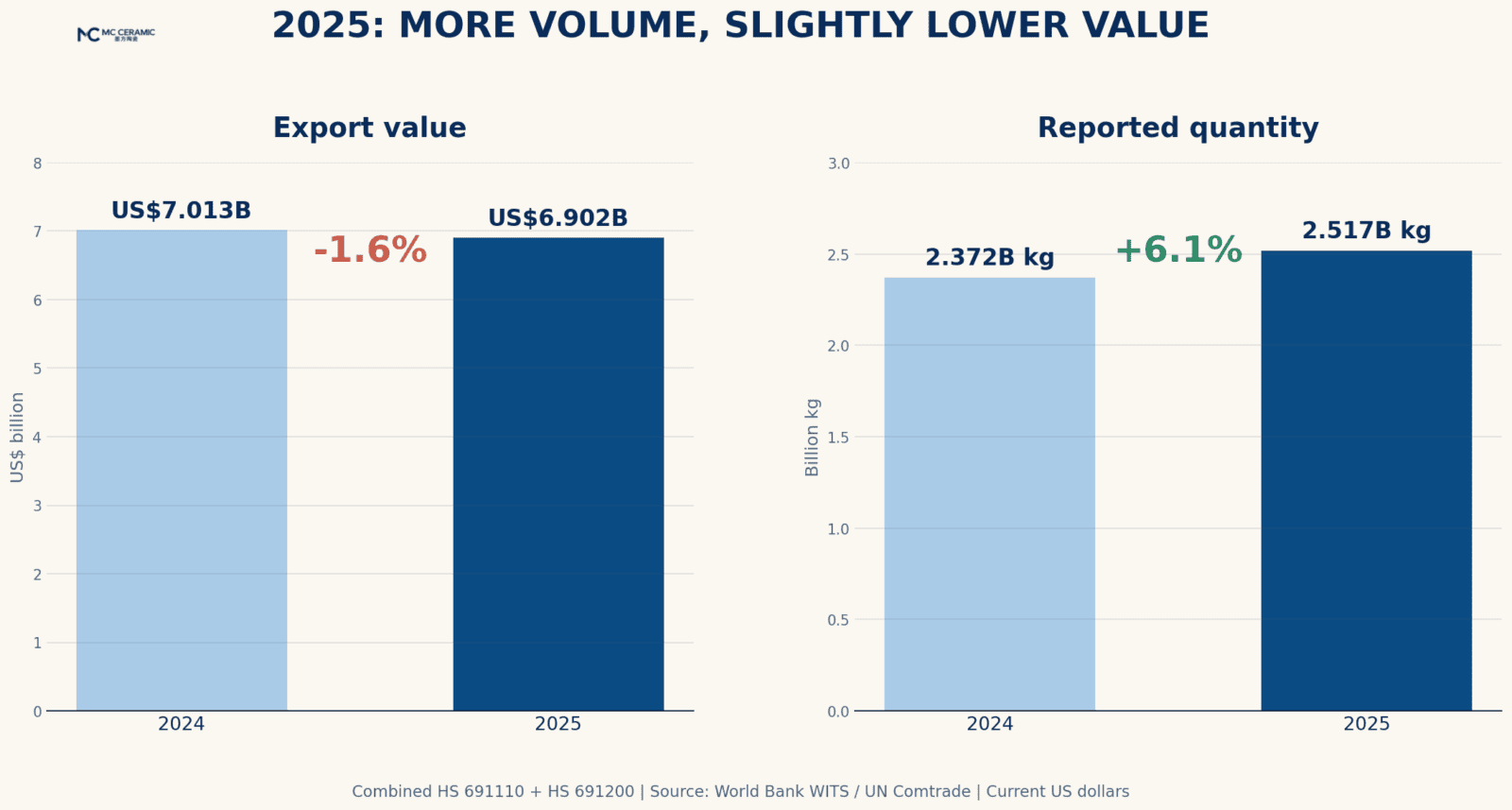
Caption: Combined export value eased 1.6% while reported quantity increased 6.1% in 2025.
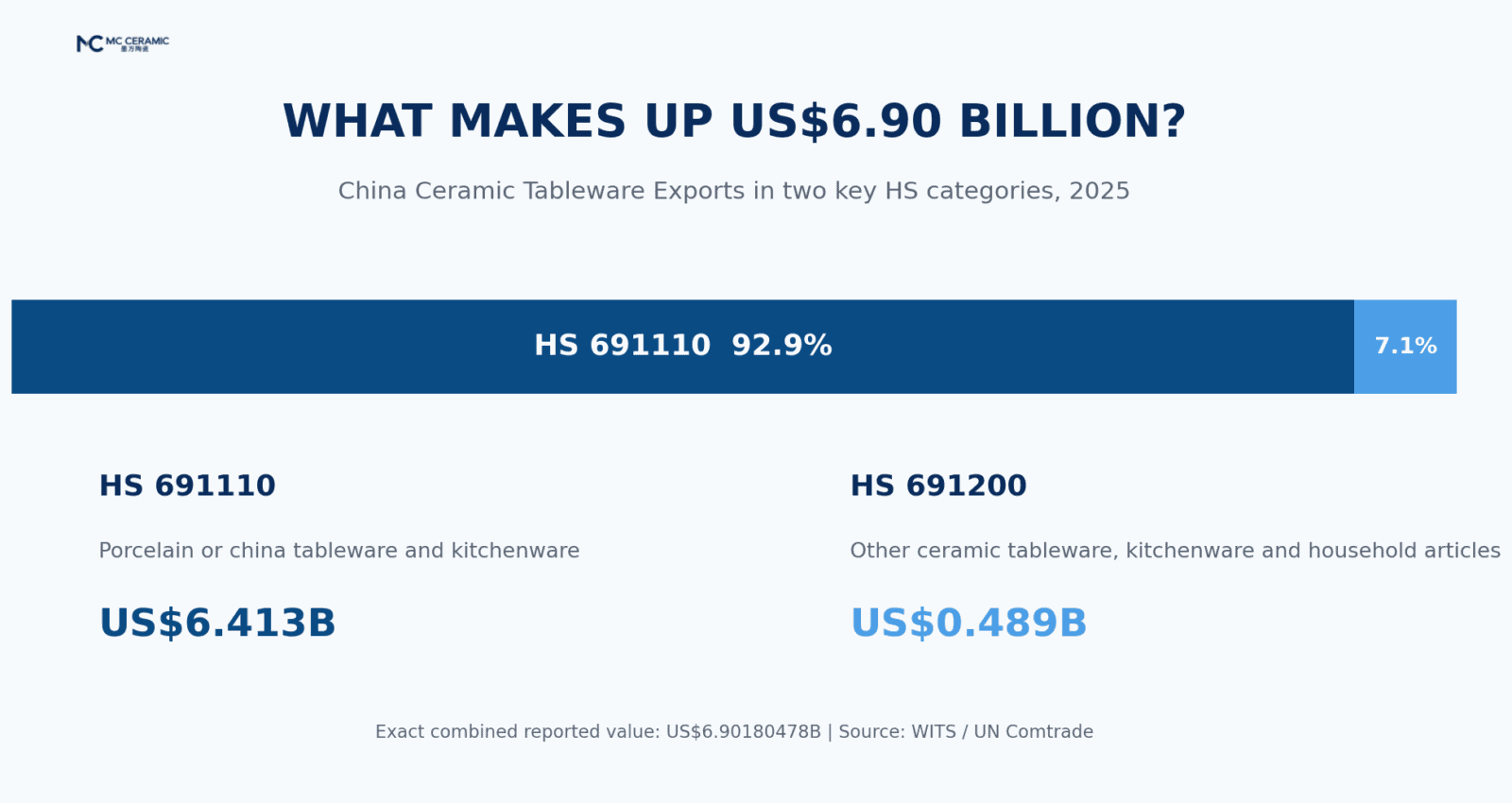
Caption: HS 691110 contributed 92.9% and HS 691200 contributed 7.1% of the combined 2025 value.
Why the 2025 Change Matters to 2026 Buyers
The combination of slightly lower value and higher quantity suggests intense competition and a shift toward lower-value-per-kilogram shipments, although customs data alone cannot identify the exact cause.
For 2026 buyers, this means a low quotation should be examined rather than applauded on sight. The price may reflect a standard shape, simpler decoration or efficient production. It may also exclude molds, decal setup, testing, stronger packaging or quality inspection.
A mysteriously cheap quote often becomes much less mysterious after the missing items enter the conversation.
The United States remained the largest named destination in both 2025 WITS tables. Combined exports to the United States were approximately US$967.4 million under the two categories, compared with about US$1.172 billion in 2024.
This does not mean American demand disappeared. It does mean suppliers and buyers should not assume that last year’s product mix, price point or sales channel will behave in exactly the same way in 2026.
MC Ceramic reads the US$6.90 Billion headline as evidence of both scale and pressure. China has deep ceramic production capacity, but capacity does not automatically produce a suitable product.
Buyers still need clear specifications, approved samples and realistic quality criteria. Kilns are excellent at firing porcelain and terrible at reading minds.
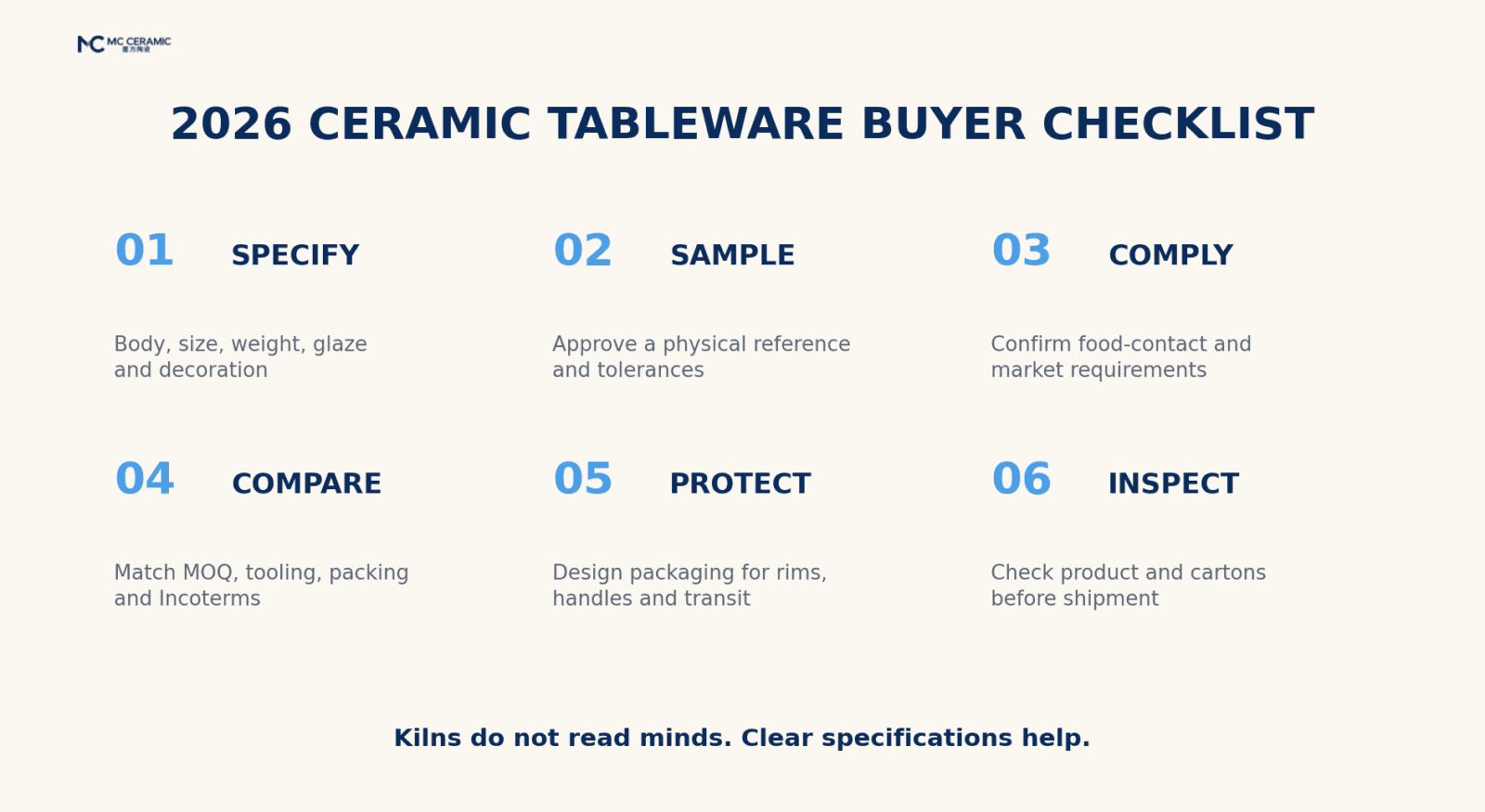
Caption: A six-step sourcing checklist for ceramic tableware buyers in 2026.
A Practical Checklist for 2026 Buyers
First, define the product before requesting a final price. State the ceramic body, item dimensions, target weight, shape, glaze, decoration method, logo position, back stamp, quantity by item and packaging format.
If the project includes a custom mold, identify who owns the mold and how revisions will be handled.
Second, use an approved sample as the physical production reference. Photographs help, but glaze, weight, balance, foot polishing and stacking are difficult to approve through a screen.
The sample should be connected to written tolerances covering size, warpage, glaze variation, decoration placement and appearance. This is less dramatic than opening a container full of surprises—which is exactly the point.
Third, confirm compliance for the destination market. Food-contact requirements, lead and cadmium limits, labeling, microwave or dishwasher claims and test reports should be discussed before production.
The applicable rules depend on the product and destination, so buyers should use qualified laboratories, import advisers and current local regulations rather than relying on a cheerful message that simply says “no problem.” Cheerfulness is welcome; evidence is better.
Fourth, compare quotations on the same basis. Check whether the price includes development, molds, samples, decoration setup, unit packaging, master cartons, testing, inspection and the agreed Incoterm.
Confirm whether minimum order quantity applies per shape, per color, per design or per complete collection. US$6.90 Billion describes a huge export market, but one purchase order can still be derailed by one unclear MOQ.
Fifth, treat packaging as part of the product. Plates need rim protection, cups need handle protection and decorated surfaces should not rub during transit.
E-commerce packs and hospitality cartons have different jobs. If the carton fails, the tableware becomes a very expensive jigsaw puzzle.
Finally, inspect before shipment. The inspection plan should refer to the approved sample and written specifications.
Buyers should agree on acceptable variation, critical defects, sampling methods, packing checks and photographic records. China Ceramic Tableware Exports are measured at the border; commercial success is measured after the goods arrive intact and usable.
How MC Ceramic Supports Ceramic Sourcing
MC Ceramic is the ceramic brand of Jiangxi Mofang Culture Development Co., Ltd. The brand works as a Jingdezhen ceramic supplier and project partner, coordinating product selection, customization, sampling, suitable production resources, production follow-up, quality checks, packaging and delivery planning.
MC Ceramic does not need to pretend that one workshop performs every specialized ceramic process. Jingdezhen’s strength comes from its network of skills, and the useful job is to coordinate that network clearly.
For importers, hospitality suppliers, distributors and private-label brands, MC Ceramic can help turn a broad request into a workable specification and sampling plan.
This is especially relevant in 2026, when buyers face price pressure but still need reliable quality, compliance and packaging. A lower unit price is nice; a lower total risk is usually nicer.
Conclusion
China Ceramic Tableware Exports reached US$6.90 Billion in 2025 across HS 691110 and HS 691200. The exact combined reported figure was US$6.90180478 billion.
Compared with 2024, export value decreased by approximately 1.6%, while reported quantity increased by around 6.1%.
For 2026 buyers, the sensible response is not to chase the lowest number on a quotation. It is to define the product, approve the sample, verify compliance, lock the packaging requirements and inspect before shipment.
江西省墨方文化发展有限公司, through its brand MC Ceramic, supports international buyers with ceramic sourcing and project coordination in Jingdezhen.
MC Ceramic helps connect design, customization, sampling, production follow-up, quality control, packaging and delivery planning, so that the US$6.90 Billion market becomes a practical sourcing opportunity rather than a very large pile of plates.
Sources and Data Scope
The figures combine HS 691110 and HS 691200 and use current US-dollar trade values reported by China. HS 691200 includes other ceramic household articles. Data accessed on 17 November 2026.
- World Bank WITS and UN Comtrade — China exports of HS 691110 in 2025:
https://wits.worldbank.org/trade/comtrade/en/country/CHN/year/2025/tradeflow/Exports/partner/ALL/product/691110 - World Bank WITS and UN Comtrade — China exports of HS 691200 in 2025:
https://wits.worldbank.org/trade/comtrade/en/country/CHN/year/2025/tradeflow/Exports/partner/ALL/product/691200 - World Bank WITS and UN Comtrade — China exports of HS 691110 in 2024:
https://wits.worldbank.org/trade/comtrade/en/country/CHN/year/2024/tradeflow/Exports/partner/ALL/product/691110 - World Bank WITS and UN Comtrade — China exports of HS 691200 in 2024:
https://wits.worldbank.org/trade/comtrade/en/country/CHN/year/2024/tradeflow/Exports/partner/ALL/product/691200 - United Nations Statistics Division — International Merchandise Trade Statistics and UN Comtrade:
https://unstats.un.org/unsd/trade/imts/
Company website: https://jingdezhen-china.com/