Custom Ceramic Tableware from Jingdezhen: Buyer’s Guide
News 2026-11-13 107
JINGDEZHEN, China — November 13, 2026
For international importers, hospitality groups, restaurant suppliers, distributors, designers, project contractors, and private-label brands, purchasing Custom Ceramic Tableware is not simply a matter of choosing a shape or pattern. It is a complete sourcing project connecting design, function, cost, production, quality control, packaging, compliance, and international delivery.
This Buyer’s Guide explains the key decisions buyers should make before placing an order in Jingdezhen and introduces how MC Ceramic supports international ceramic projects from initial concept to final delivery.
Jingdezhen has a long-established porcelain ecosystem that brings together ceramic workshops, decorators, designers, technicians, mold makers, packaging suppliers, and logistics resources. This extensive supply chain creates considerable customization flexibility, but it also makes clear specifications and professional project coordination essential.
MC Ceramic works as a Jingdezhen ceramic supplier and project partner, helping buyers from different countries complete product selection, design development, sampling, production follow-up, quality inspection, packaging, and global delivery.

1. Begin with the commercial requirements
A successful Custom Ceramic Tableware project should begin with the intended market and application rather than with artwork alone.
Hotel breakfast tableware, restaurant dinnerware, retail gift sets, airline tableware, branded promotional products, and private-label e-commerce collections may use similar plates, bowls, and cups, but their requirements can be very different.
Before requesting a quotation, buyers should define:
- Target market and customer group
- Hotel, restaurant, retail, or household application
- Expected price level
- Estimated order quantity
- Required set composition
- Replacement and repeat-order plans
- Packaging and distribution channels
Different markets may also have different preferences. European buyers may focus on minimalist design and environmental packaging, Middle Eastern hospitality projects may prefer decorative collections and gold details, while restaurant and hotel buyers in other regions may prioritize durability, stackability, and stable replacement supply.
The first recommendation in this Buyer’s Guide is to approve the commercial brief before beginning sampling. A clear brief allows MC Ceramic to recommend more suitable ceramic bodies, shapes, decoration methods, and production routes in Jingdezhen.
2. Select the ceramic body, shape, and finish
Material choice affects appearance, durability, weight, cost, and customer experience.
Fine porcelain provides a clean white body and a refined appearance. Stoneware offers a heavier and more natural feeling, making it popular for casual restaurants and lifestyle brands. Buyers should also compare rim design, foot rings, wall thickness, product weight, stackability, and the balance between cups and handles.
Existing shapes usually reduce development costs and support more flexible minimum order quantities. New molds can create stronger product differentiation but require additional investment in tooling, testing, and production preparation.
Decoration options for Custom Ceramic Tableware may include:
- Plain white porcelain
- Color glaze
- Underglaze decoration
- Ceramic decals
- Hand-painted patterns
- Gold or platinum details
- Embossed logos
- Customized back stamps
- Mixed decoration techniques
Jingdezhen is particularly valuable when a project requires coordination between shape production and specialist decoration.
Buyers should review physical color samples under consistent lighting conditions. Fired ceramics may have small, controlled variations in color, glaze flow, and hand-finished details. These variations should be discussed and defined before production.
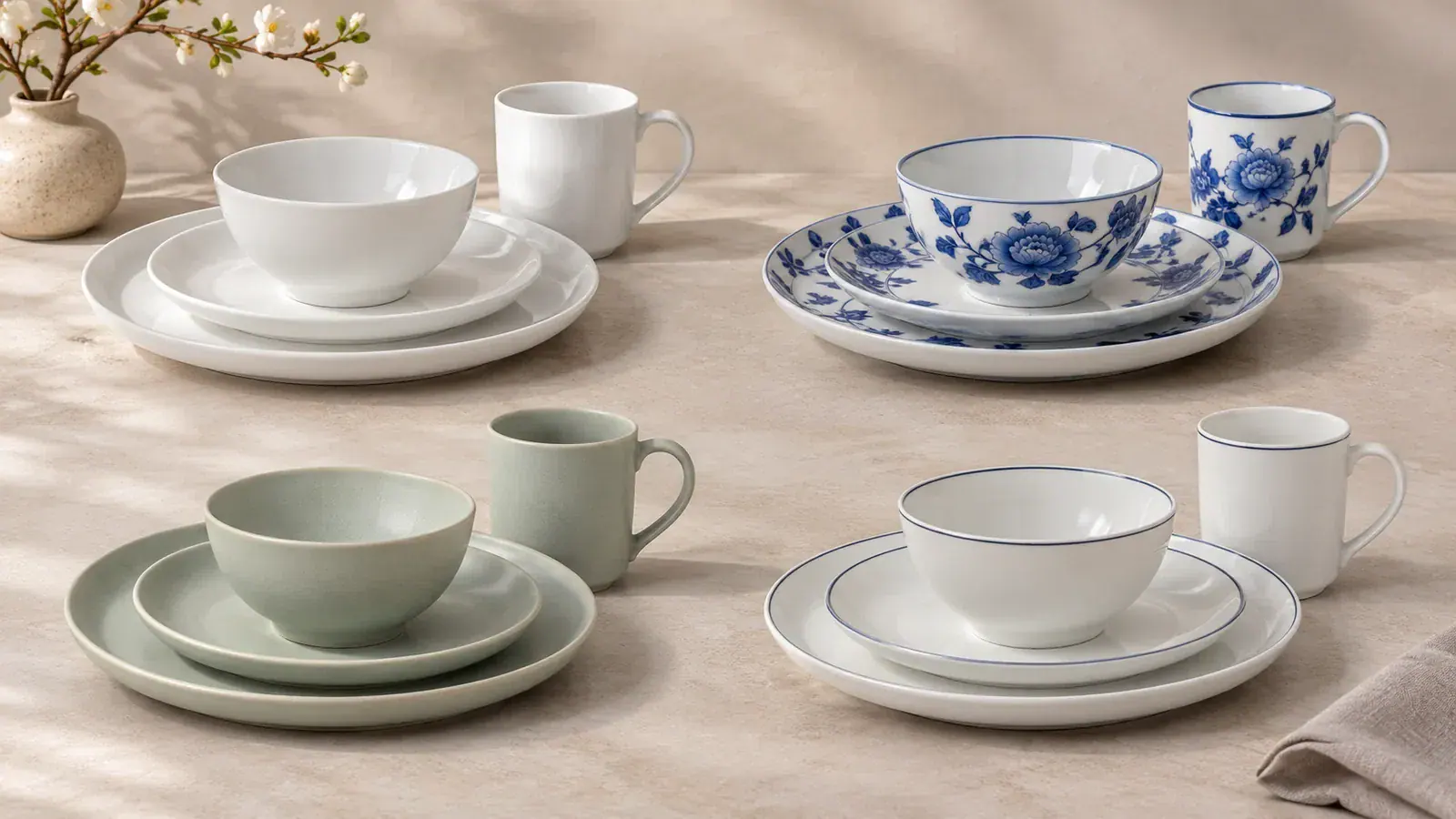
Commercial customization options can combine shape, glaze, color and decoration.
3. Convert the design into a measurable specification
A design rendering or mood board can communicate the creative direction, but it cannot replace a complete production specification.
The product specification should state:
- Product dimensions and permitted tolerances
- Target product weight
- Ceramic body and glaze requirements
- Decoration coverage
- Logo and back-stamp position
- Set composition
- Quantity for each item
- Packaging method
- Acceptable natural variations
- Unacceptable defects
These details reduce subjective decisions during production.
MC Ceramic recommends preparing an independent specification for every product in the collection. If the Custom Ceramic Tableware collection includes a dinner plate, side plate, bowl, mug, cup and saucer, or serving piece, each item should have its own approved dimensions, colors, decoration placement, and quality requirements.
For continuous rim patterns, reactive glazes, hand-painted decoration, or coordinated collections, buyers should also identify the main viewing area and critical matching requirements between different pieces.
4. Use sampling as the approval stage
Sampling is the stage where a Custom Ceramic Tableware concept becomes a physical product.
A professional sample review should cover more than appearance. Buyers should check:
- Weight and balance
- Surface texture
- Stackability
- Handle comfort
- Foot-ring polishing
- Glaze appearance
- Pattern placement
- Logo and back-stamp position
- Color consistency
- Coordination between different products
When possible, the buyer’s designer, purchasing department, quality team, or final user should participate in the sample review.
The approved sample should become the main reference for shape, color, decoration, and workmanship. Any requested changes should be recorded in writing and reflected in a revised sample or formal approval document.
This Buyer’s Guide treats the approved sample as one of the most important control points. Descriptions such as “make the white warmer” or “make it look more premium” are too subjective to guide stable production.
MC Ceramic can coordinate sample development in Jingdezhen and consolidate buyer comments before mass production begins.
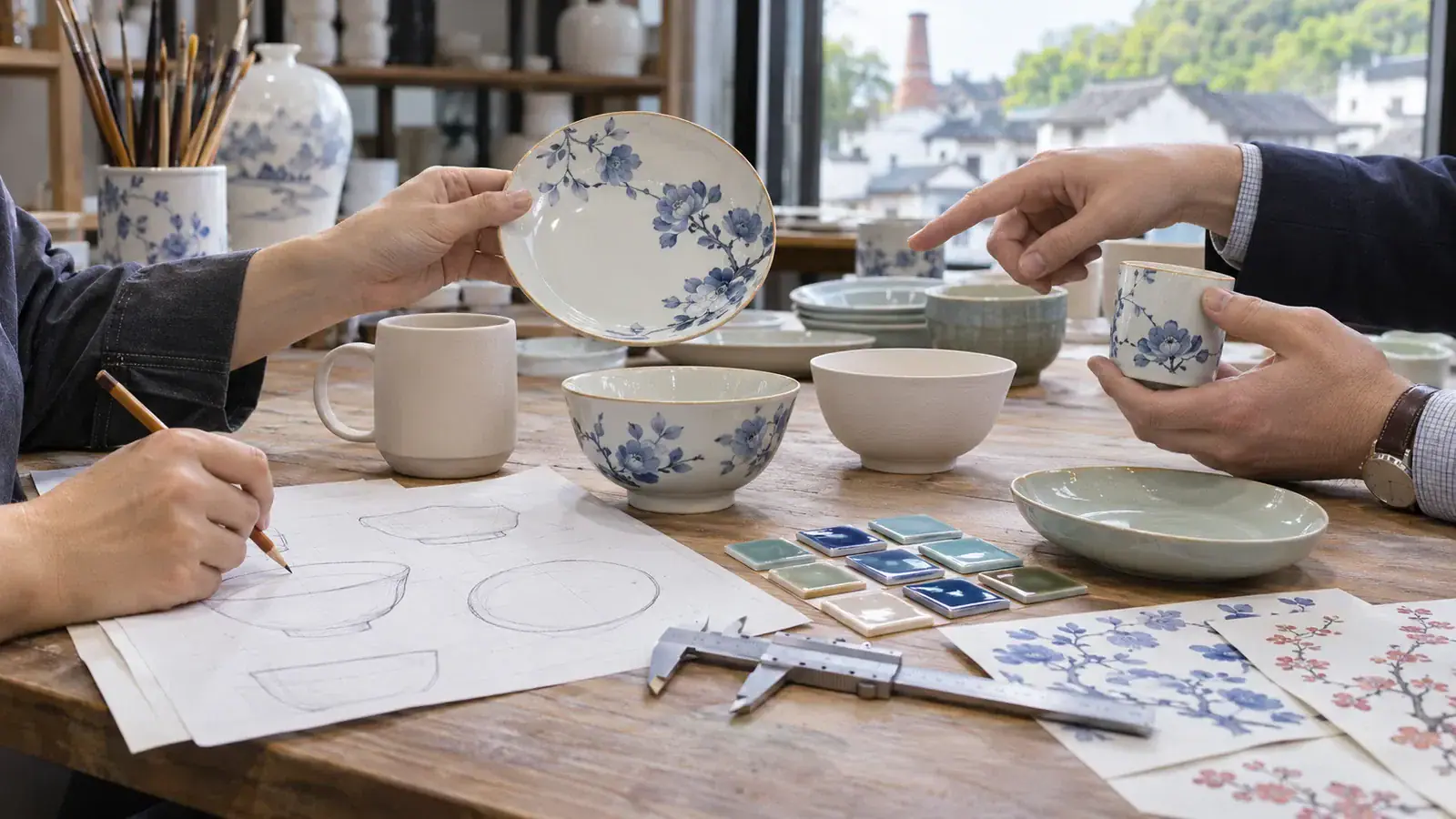
Design review and sampling convert a creative idea into an approved production reference.
5. Understand MOQ, pricing, and lead time
There is no single minimum order quantity for every Custom Ceramic Tableware project.
MOQ depends on whether the project uses:
- Existing ceramic shapes
- Newly developed molds
- Standard or customized glazes
- Decal or hand-painted decoration
- Gold or platinum finishing
- Customized retail packaging
- One design or multiple designs
Buyers seeking a lower opening quantity can usually obtain more flexible options by selecting existing shapes and customizing the glaze, pattern, logo, back stamp, or packaging.
A completely exclusive shape normally requires a larger order because mold development, testing, and production setup costs must be covered.
A professional quotation should clearly identify mold or development charges, sample fees, unit prices, decoration setup, packaging costs, testing costs when applicable, and trade terms.
Buyers should confirm whether MOQ is calculated per item, per shape, per color, per pattern, or per complete collection.
Lead time should be divided into design confirmation, sampling, material preparation, ceramic production, decoration, inspection, packaging, and international transportation. MC Ceramic supports flexible customization, but actual production time depends on the selected process and approved specifications.
6. Define quality control and compliance requirements
Ceramics are fired products, so quality standards must distinguish acceptable natural variations from defects that affect function, safety, or presentation.
Before production, buyers and suppliers should agree on standards covering:
- Glaze color
- Product warpage
- Pinholes and black spots
- Decoration alignment
- Rim condition
- Foot-ring finish
- Rocking
- Cracks and chips
- Set-to-set consistency
- Packaging and quantity accuracy
Inspection should follow the approved sample and written tolerances. For larger orders, buyers may define a sampling level with their internal quality department or a third-party inspection company.
Compliance requirements may differ by destination country. Depending on the product and market, buyers may need to verify food-contact safety, lead and cadmium release, labeling, packaging materials, barcode information, and import documentation.
Rather than applying one standard to every destination, buyers should confirm the specific requirements of their target market with qualified laboratories, customs advisers, and local import specialists.
MC Ceramic can coordinate production quality follow-up, pre-shipment inspections, product photographs, quantity checks, and packaging verification in Jingdezhen.
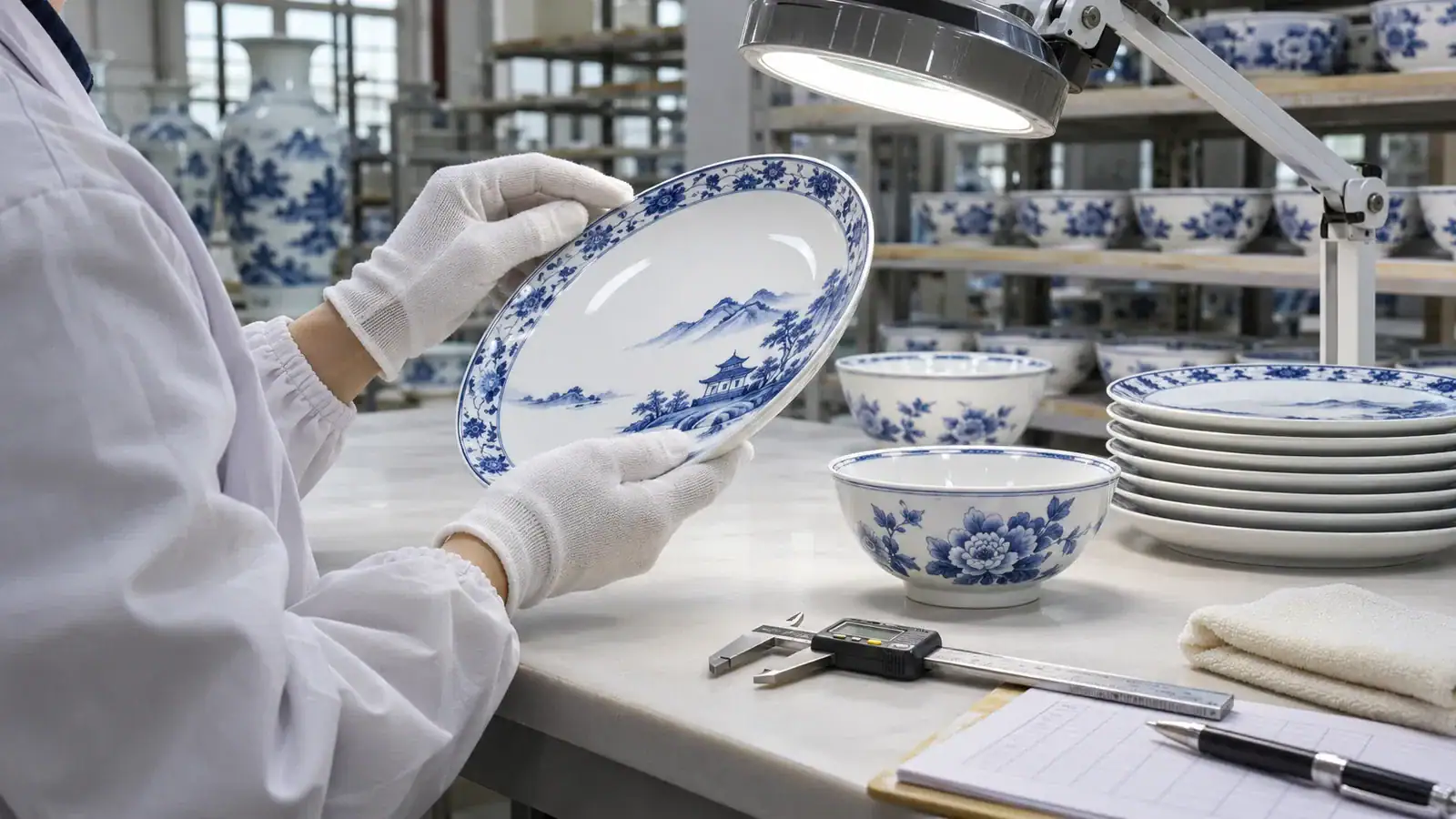
Quality criteria should be agreed before production and checked against the approved sample.
7. Plan packaging and international delivery
Packaging should be designed according to the sales channel and transportation method.
Hospitality cartons normally prioritize efficient handling, storage, and replacement supply. Retail and e-commerce packaging may require gift boxes, barcodes, product information, molded inserts, and stronger drop protection.
Plates need adequate rim protection, cups require handle protection, and decorated ceramic surfaces should not rub against each other during transportation.
Before packing, buyers should confirm:
- Inner packaging structure
- Quantity per carton
- Master-carton dimensions
- Net and gross weight
- Pallet configuration
- Shipping marks
- Barcode and label requirements
- Drop-protection requirements
Sea freight, air freight, railway transport, and combined transportation may have different packaging and delivery requirements. The destination country, order volume, delivery schedule, and product value should all be considered when selecting the shipping method.
The recommendation in this Buyer’s Guide is to approve packaging together with the product sample. A well-designed Custom Ceramic Tableware collection can still suffer losses if the packaging is unsuitable for international transportation.
MC Ceramic can coordinate customized packaging, export cartons, pallet preparation, and global delivery planning from Jingdezhen.
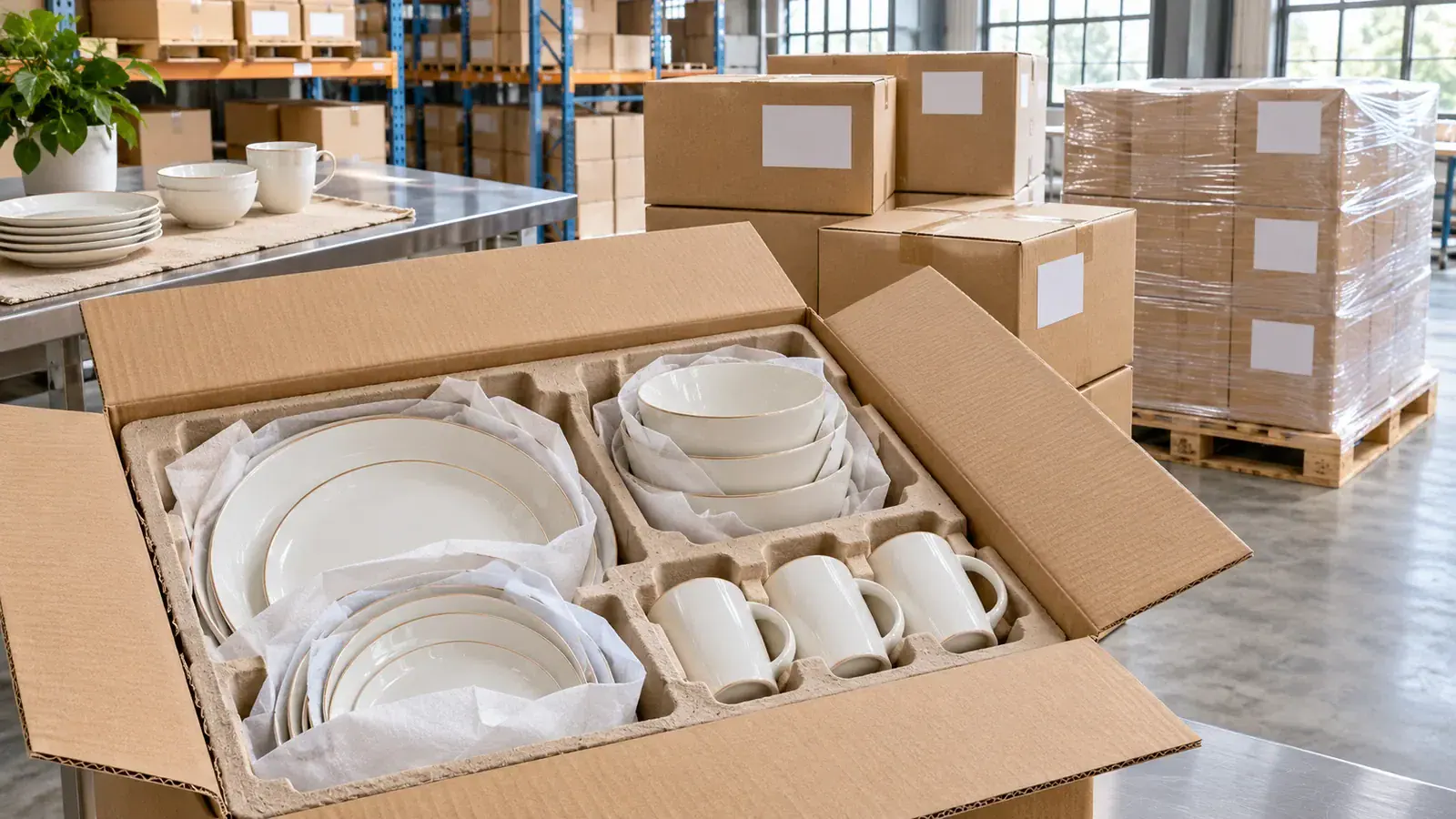
Export packaging should protect rims, handles and decorated surfaces throughout delivery.
8. Choose a partner capable of managing the complete project
Buyers often compare suppliers only by unit price. However, the real sourcing cost also includes communication, repeated sampling, quality risks, production coordination, breakage, and delivery delays.
A reliable supplier should explain which ceramic body, workshop, decoration method, and production process are suitable for each product. It should also identify risks early and maintain one approved specification throughout the order.
MC Ceramic positions itself as a Jingdezhen ceramic supplier and project partner rather than as a single factory claiming to complete every ceramic process internally.
Its role is to coordinate suitable workshops, designers, technicians, quality-control resources, packaging suppliers, and logistics solutions for standard collections, Custom Ceramic Tableware, and project-based ceramic requirements.
This model allows international buyers to access the specialized capabilities of Jingdezhen while working with one project contact and a clearer sourcing process.
Buyer’s Guide Final Checklist
Before placing an order, buyers should confirm:
- Target market and commercial application
- Product list and set composition
- Dimensions, weight, and tolerances
- Ceramic body, glaze, and decoration method
- Logo, back stamp, packaging, and labeling
- Approved samples and written modification records
- MOQ calculation and price breakdown
- Production and delivery schedule
- Quality standards and inspection methods
- Destination-market compliance requirements
- Trade terms and payment terms
- Carton specifications and shipping method
Conclusion
Sourcing Custom Ceramic Tableware from Jingdezhen works best when design, sampling, production, quality control, packaging, compliance, and logistics are managed as one connected project.
A clear commercial brief and an approved sample protect both the creative objective and the commercial result. This Buyer’s Guide provides international buyers with a practical framework for requesting quotations, comparing solutions, controlling quality, and reducing sourcing risks.
Jiangxi Mofang Culture Development Co., Ltd.(江西省墨方文化发展有限公司), through its brand MC Ceramic, supports buyers around the world with Jingdezhen ceramic sourcing, flexible customization, sample development, project coordination, quality follow-up, customized packaging, and international delivery planning.