Ceramic Customization · Hidden Risks in Jingdezhen Custom Orders
News 2026-08-10 25
Ceramic Customization Offers Opportunity—but Also Hidden Risk
Ceramic Customization has become a popular sourcing model in the global home décor, premium tableware, corporate gift, and branded merchandise markets. Compared with standard in-stock products, customized ceramics can be developed around a brand’s identity, target customer, sales channel, and preferred aesthetic.
Buyers may customize the shape, dimensions, glaze color, decoration, logo, and packaging. Whether the order involves premium decorative objects, interior accessories, corporate gifts, retail tableware, or branded collections, Jingdezhen porcelain offers strong possibilities for product differentiation.
Supported by Jingdezhen’s established ceramic supply chain, manufacturers can develop blue-and-white porcelain, Linglong porcelain, antique-style porcelain, art ceramics, and large ceramic installations. These products combine traditional Chinese craftsmanship with commercial design, giving them considerable appeal in international markets.
However, many buyers focus mainly on the appearance of the approved sample, quoted unit price, and promised lead time. They may overlook the production risks behind Ceramic Customization. Common problems include color variation, deformation, reduced decorative detail, failed compliance testing, excessive defects, and shipping damage.
This is why buyers sometimes receive a perfect sample but an inconsistent bulk order. Unlike standard in-stock purchasing, Ceramic Customization is a nonstandard production process. Every supplier may use different clay bodies, glaze formulas, kilns, firing schedules, quality standards, and inspection methods.
Without clear specifications and written acceptance standards, a custom order can result in delays, rejected shipments, returns, compensation claims, or damage to the buyer’s brand reputation. This guide explains the risks commonly overlooked by importers, brand buyers, hospitality purchasers, and cross-border sellers.
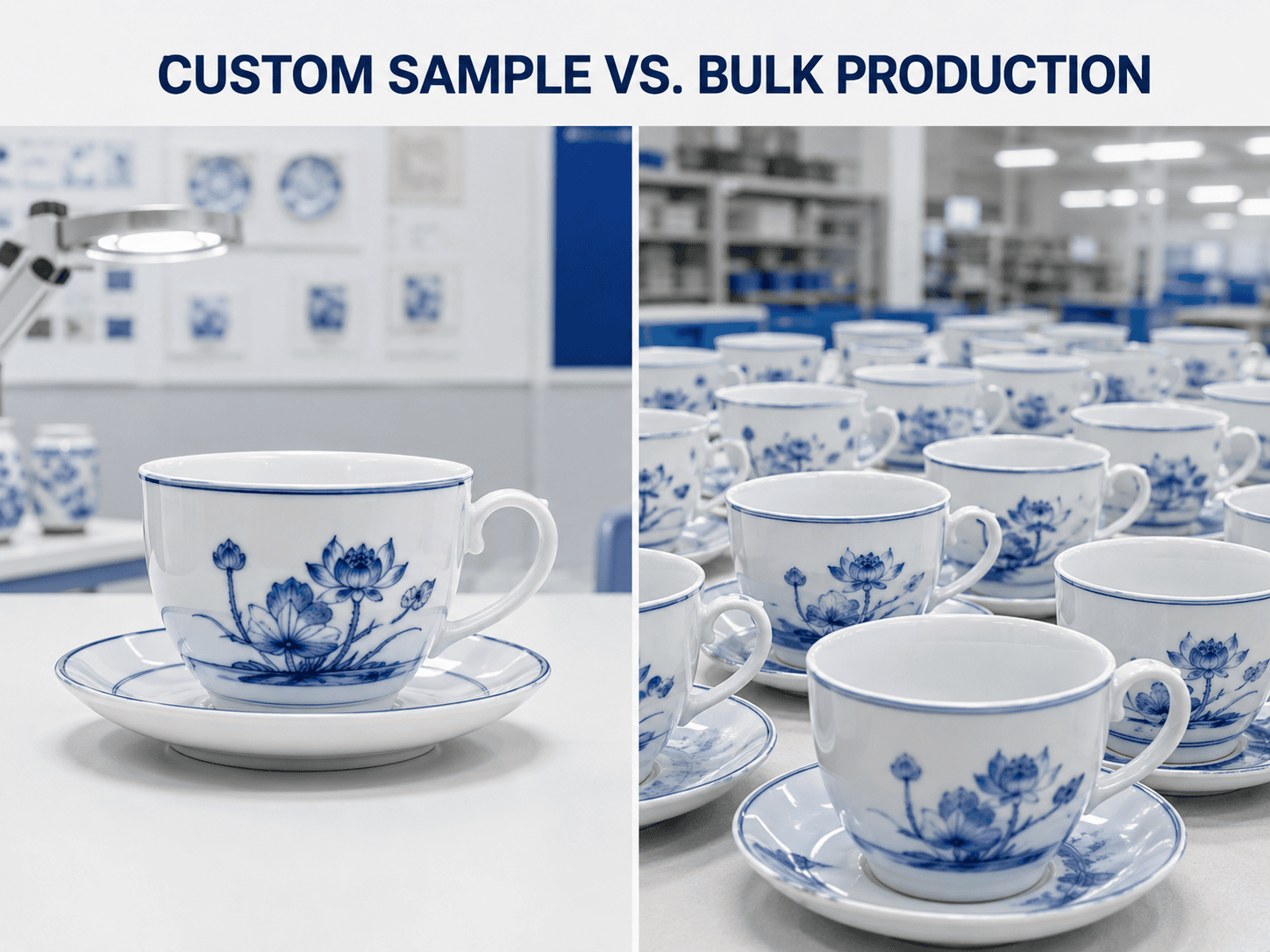
Sampling Risks: A Sample Is Not Automatically the Mass-Production Standard
One of the biggest misunderstandings in Ceramic Customization occurs during sampling. After approving one sample, buyers often assume that every unit in the final order can be reproduced exactly. In ceramic production, that expectation may be unrealistic unless acceptable tolerances are agreed upon in advance.
Jingdezhen ceramic products include blue-and-white porcelain, Linglong porcelain, art ceramics, antique-style porcelain, and large ceramic installations. Each category involves different production difficulties. A hand-painted vase cannot be evaluated in the same way as a decal-decorated cup, and a large sculptural piece cannot follow the same tolerances as standardized hotel tableware.
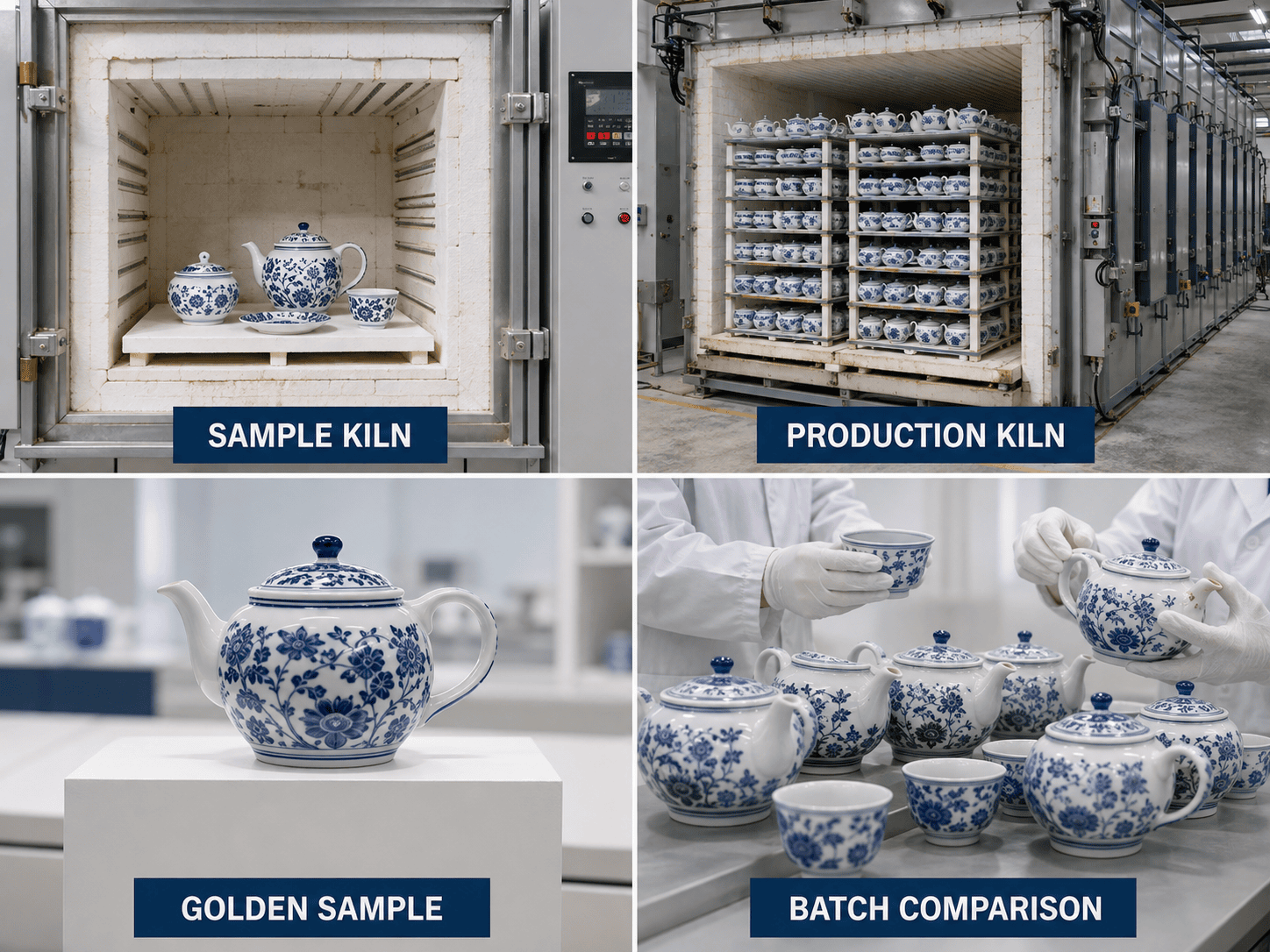
Differences Between Sample and Production Kilns
A custom sample may be fired separately in a small kiln or carefully controlled kiln load. The kiln may contain fewer pieces, allowing greater control over placement, airflow, temperature, and finishing.
Bulk Ceramic Customization orders are usually fired in larger and more densely loaded kilns. Temperature differences, kiln atmosphere, airflow, and product placement can influence the final appearance. Blue-and-white decoration may develop slight differences in cobalt intensity, Linglong porcelain may vary in translucency, and reactive or artistic glazes may shift in color and texture.
These variations are natural characteristics of ceramic production, but they must be managed. The buyer should ask whether the sample and bulk order will use the same clay body, glaze formula, pigment, firing temperature, kiln type, and production process.
Using better materials for the sample and different materials for production would create an unacceptable gap. To prevent this, all approved materials and formulas should be recorded in the product specification.
Details May Change During Mass Production
Custom orders often include hand-painted decoration, exclusive decals, laser-marked logos, gilded rims, silver accents, or special glazes. During sample development, craftspeople may spend considerable time refining every detail.
During bulk production, time pressure and cost control can affect consistency. If procedures are not clearly defined, some production steps—such as trimming, surface smoothing, glaze correction, edge finishing, or decoration inspection—may receive less attention.
The result may include blurred logos, uneven lines, incomplete patterns, glaze defects, inconsistent gilding, or missing details. These differences can be especially serious for branded products because visual consistency is often a strict retail requirement.
Buyers should therefore approve more than one sample whenever possible. A “golden sample” should define the target appearance, while limit samples should show the maximum acceptable variation.
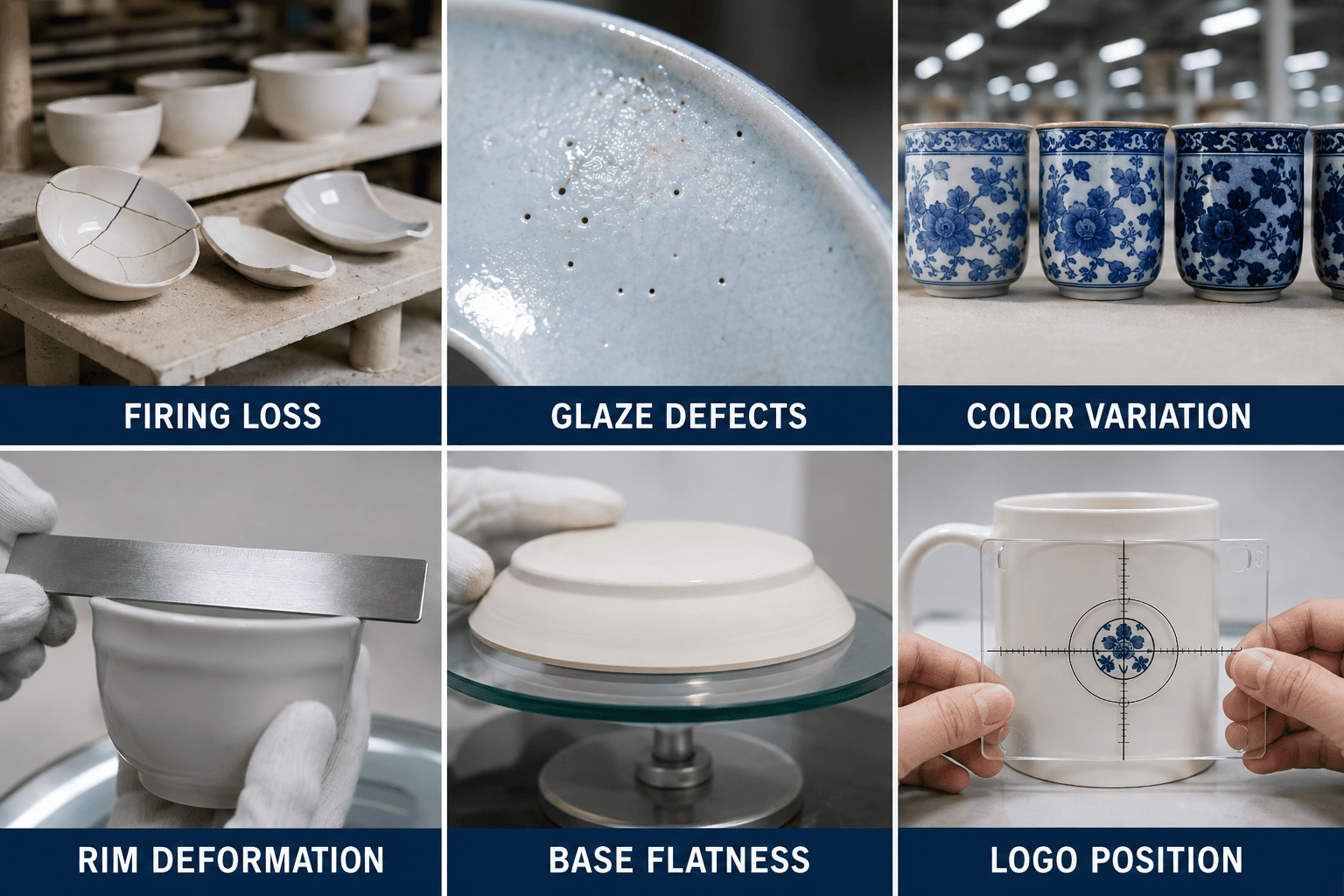
Mass-Production Risks: Loss Rates, Color Variation, and Quality Control
The risks of Ceramic Customization become more visible during mass production. Many Jingdezhen custom products combine machine-assisted forming with manual processes, so some variation is unavoidable.
This applies to customized blue-and-white and Linglong tableware as well as art ceramics, antique-style porcelain, and ceramic installations. The important question is not whether variation exists, but whether it remains within an agreed and commercially acceptable range.
Production Loss and Defect Rates
Every ceramic order has an expected production loss rate. Unusual shapes, thin porcelain bodies, large dimensions, complex reliefs, openwork, and difficult glazes generally increase the risk of cracking, warping, glaze defects, or firing failure.
Buyers should ask how the supplier calculates production loss and whether the quotation is based on the ordered quantity or the final accepted quantity. They should also confirm how rejected pieces will be handled and whether extra units will be produced as replacements.
If the loss rate is higher than expected, the supplier may need additional time for replacement production. Without a written agreement, this can delay shipment. More seriously, pieces with minor defects may be mixed into the final order if acceptance standards have not been clearly established.
For antique-style products, handcrafted variation and intentional aging effects must be separated from genuine manufacturing defects. A distressed surface may be part of the approved design, but cracks, unstable bases, sharp edges, missing glaze, or structural damage should not be accepted merely as “handmade character.”
Batch-to-Batch Color Differences
Color consistency is essential for overseas brands, retail chains, and hospitality projects. Small changes in glaze composition, pigment concentration, firing temperature, kiln atmosphere, or product placement can create visible batch differences.
Color variation may be acceptable for one-of-a-kind art ceramics or reactive-glaze installations. For branded gifts, coordinated tableware sets, blue-and-white collections, or Linglong porcelain sold through retail channels, excessive variation can make product matching and replenishment difficult.
Before production, buyers should establish an approved color range using physical samples rather than relying only on digital images. Production pieces should be inspected under consistent neutral lighting, and different kiln batches should be compared before packaging.
Deformation and Dimensional Variation
Unusual shapes and large customized pieces are more likely to deform during high-temperature firing. Possible issues include uneven rims, unstable bases, shifted curves, changes in height, or differences in opening diameter.
Even minor deformation can affect stacking, lid fit, balance, packaging, and retail presentation. For hotel tableware, dimensional inconsistency may prevent plates and bowls from stacking safely. For lidded jars or tea ware, it may affect the fit between components.
Custom specifications should therefore include measurable tolerances for height, diameter, capacity, weight, flatness, and lid fit where applicable.
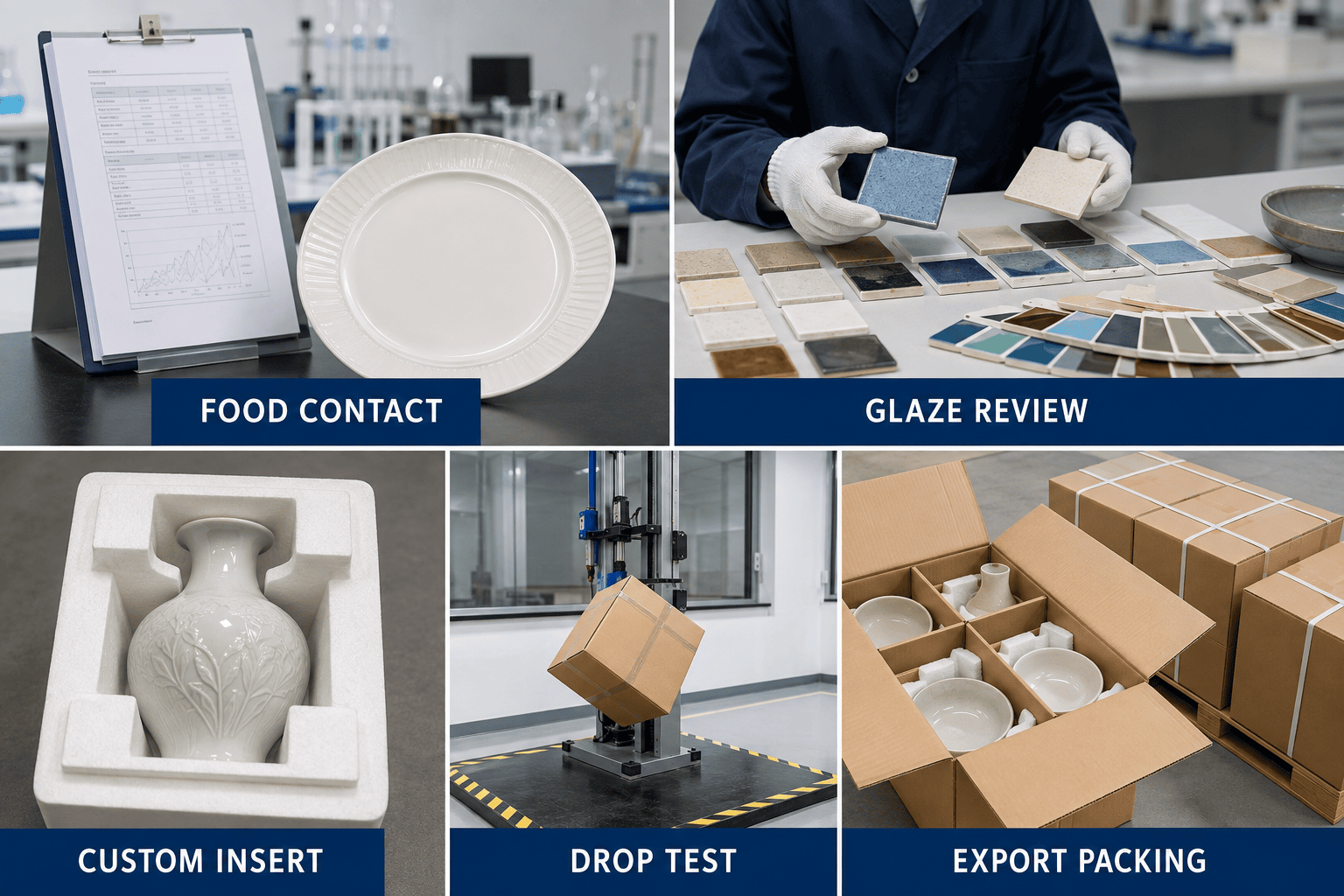
Compliance and Logistics: Two Risks Buyers Often Overlook
Many buyers pay close attention to appearance but underestimate compliance and shipping requirements. These areas can lead to customs delays, rejected goods, or substantial financial losses.
Food-Contact Compliance
Different destination markets apply different requirements to ceramic products intended for food contact. Depending on the market and product, buyers may need testing for lead and cadmium migration, glaze stability, decoration safety, or other restricted substances.
Colored glazes, special artistic glazes, and heavily decorated products may use more complex pigment and glaze systems than plain white porcelain. This does not automatically make them unsafe, but it means the finished product should be assessed according to its intended use and target market.
Decorative art porcelain and ceramic installations that are not intended for food contact do not follow the same use requirements as plates, bowls, mugs, and tea ware. Problems arise when a display-only formula or decoration is transferred to a food-contact product without appropriate review and testing.
Claims such as “high-fired,” “lead-free,” “underglaze,” or “made from Jingdezhen kaolin” do not replace finished-product testing. Reports should correspond to the actual shape, glaze, decoration, and production batch being purchased.
Products intended for children, food service, or frequent commercial use may require additional attention. Buyers should tell the manufacturer where the product will be sold and how it will be used before sampling begins.
Custom Packaging and Shipping Damage
Customized ceramics often have unusual shapes or exclusive dimensions that do not fit standard packaging. Compared with regular in-stock products, they may require custom inserts, molded pulp, foam protection, dividers, reinforced cartons, or wooden crates.
If packaging is designed only after production, the finished product may not fit securely. Large empty spaces, insufficient cushioning, weak carton walls, or contact between ceramic surfaces can increase damage during sea or air transportation.
Packaging should be considered during product development, not after the order is finished. Buyers should request a complete packed sample and, when appropriate, arrange carton drop, vibration, or compression testing.
Replacement can also be difficult. Because custom products may require new decals, special glazes, exclusive packaging, or another kiln firing, replenishment is usually slower and more expensive than replacing standard stock.
Contract and Delivery Risks: Avoid Unclear Responsibilities
Many custom-order disputes begin with incomplete contracts. Buyers and ceramic manufacturers may discuss numerous requirements through email or messaging apps but fail to include them in the final purchase agreement.
When delays, excessive defects, or quality differences occur, both parties may interpret the original agreement differently.
Hidden Lead-Time Delays
Ceramic Customization involves design, sampling, approval, material preparation, forming, drying, glazing, decoration, firing, inspection, and packaging. Complex products may require several test firings or repeated adjustments.
Production schedules can also be affected by drying conditions, kiln availability, raw-material supply, decal production, packaging development, or failed firing batches. A quoted lead time should therefore state when the schedule begins—for example, after deposit payment, final artwork approval, sample approval, or packaging confirmation.
The contract should also define how sample revisions affect the delivery date and what happens if the supplier misses an agreed deadline. Buyers planning for holidays, retail launches, trade shows, or seasonal sales should include sufficient scheduling flexibility.
No Written Defect Tolerance
Standard products may already have established inspection criteria. Customized ceramics usually require order-specific standards.
The contract should clearly define the acceptable range for:
- Color variation
- Dimensions and capacity
- Warping and flatness
- Scratches, pinholes, black spots, and glaze defects
- Logo size, position, and clarity
- Hand-painted variation
- Gilding or decal alignment
- Acceptable defect percentage
- Packaging damage and shipment breakage
What a manufacturer considers a normal handmade variation may be considered a defect by an overseas brand. Written criteria, approved samples, clear photographs, and limit samples reduce this disagreement.
The agreement should also state who is responsible for inspection, whether a third-party inspection is permitted, how rejected products will be replaced, and how costs will be handled.
Conclusion
Jingdezhen’s extensive experience in blue-and-white porcelain, Linglong porcelain, antique-style porcelain, art ceramics, and ceramic installations gives Ceramic Customization strong international market potential.
At the same time, custom ceramic production is nonstandard, technically complex, and influenced by many variables. A successful sample does not automatically guarantee an identical bulk order. Buyers must manage differences in kiln conditions, color, dimensions, craftsmanship, compliance, packaging, and delivery.
The most effective risk-control strategy is to select a manufacturer with relevant product experience, confirm the intended use and target market, document the approved materials and production process, establish measurable tolerances, and arrange appropriate testing and inspection.
Magic Cube is based in Jingdezhen and supports overseas distributors, brands, hospitality buyers, and project clients with ceramic design, sample development, OEM and ODM production, quality control, compliance coordination, and custom packaging. Before bulk production, we work with buyers to confirm product specifications, approved samples, acceptable variation ranges, inspection requirements, and intended applications.
Ceramic Customization should not depend on appearance alone. When design, production, testing, packaging, and contractual responsibilities are managed together, buyers can reduce returns, control after-sales costs, and build a more stable long-term ceramic supply chain.